
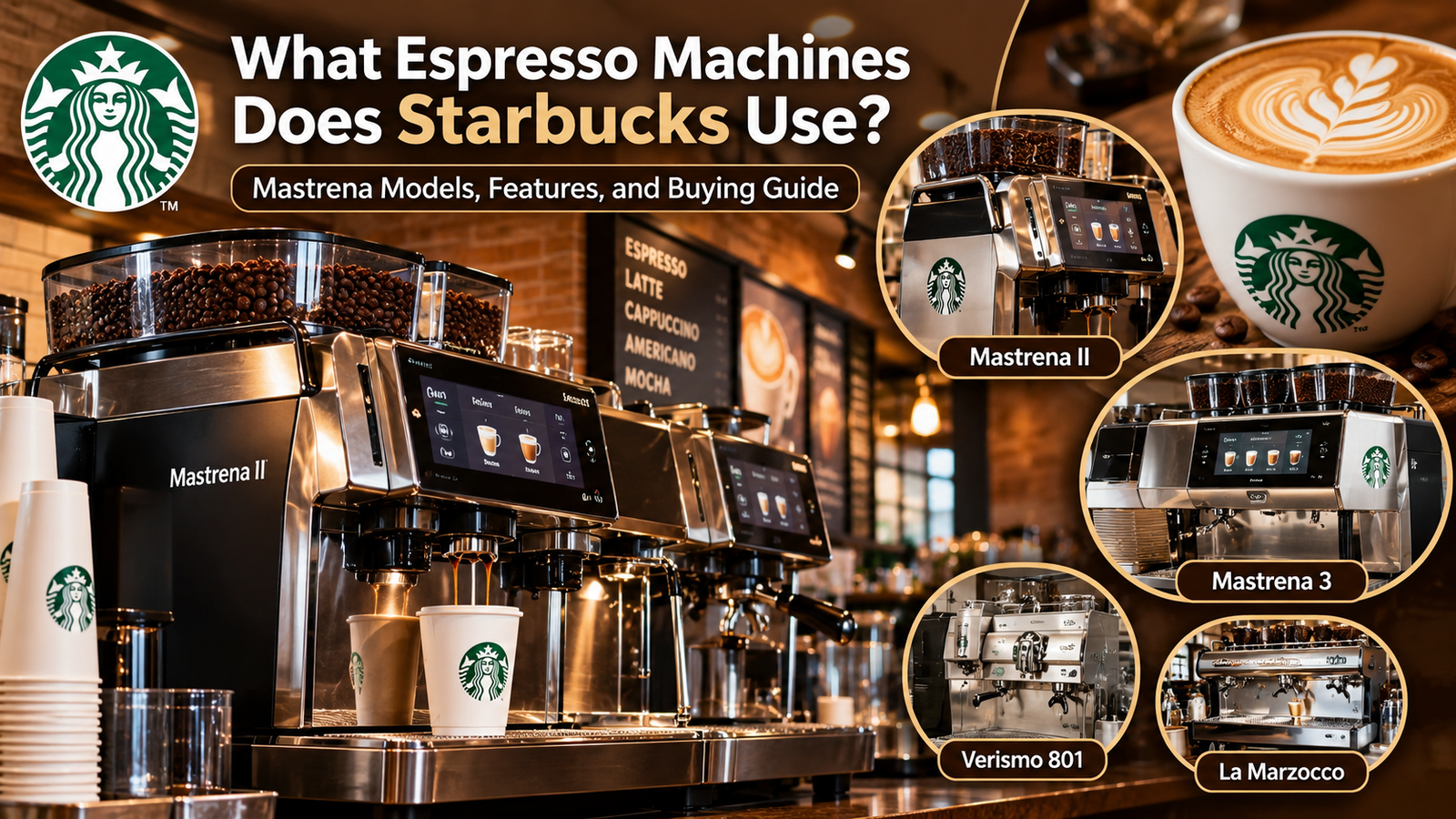
Starbucks primarily uses the Mastrena II, a commercial super-automatic espresso machine developed with Swiss manufacturer Thermoplan. The machine helps baristas prepare espresso consistently while handling large numbers of orders. In January 2026, Starbucks introduced its next-generation Mastrena 3, which the company plans to begin rolling out in 2027. Earlier Starbucks coffeehouses used equipment such as the Thermoplan Verismo 801, the original Mastrena, and La Marzocco Linea models. These machines differ significantly from typical home espresso equipment. This guide explains which models Starbucks uses, how they work, why automation matters, and how to prepare similar espresso drinks at home.
What Espresso Machines Does Starbucks Use Today?
The Mastrena II remains the best-documented espresso machine used across regular Starbucks coffeehouses in 2026. It is designed for high-volume service and repeatable espresso preparation. Starbucks has announced newer equipment, including the Mastrena 3, but a company announcement does not mean every location already has the new model. Equipment can differ by store type, location, and operational requirements.
The Mastrena II Espresso Machine in Starbucks Stores
The Mastrena II is a commercial super-automatic espresso machine designed to streamline the preparation of espresso shots. Instead of requiring baristas to manually grind, dose, tamp, and control every extraction, it automates several important steps.
This helps employees manage busy drink queues while maintaining consistent preparation procedures. The machine is designed for Starbucks operations, so it is not equivalent to an ordinary consumer bean-to-cup espresso maker.
What Is the Mastrena II Pro?
The name Mastrena II Pro sometimes appears in online discussions about Starbucks equipment. However, buyers should be careful about treating it as a separately documented, widely available product model.
Starbucks publicly identifies the Mastrena II and its newer Mastrena 3. Without reliable manufacturer specifications, it is difficult to establish exactly which features, if any, distinguish a supposed Mastrena II Pro.
For accurate comparisons, use confirmed Starbucks model names rather than unsupported variations.
What Is the New Starbucks Mastrena 3?
The Mastrena 3 is Starbucks’ next-generation proprietary espresso machine, introduced during its January 2026 Investor Day. The company says the equipment is designed to increase espresso capacity and reduce preparation time.
Starbucks described its current Mastrena II workflow as taking approximately 70 seconds to prepare four espresso shots. The newer machine is intended to reduce that time by about half while increasing capacity.
The announced rollout is scheduled to begin in 2027, so it should not be described as already installed in every U.S. store.
Do All Starbucks Locations Use the Same Espresso Machine?
Not necessarily. Starbucks operates different store formats, and equipment arrangements can change as machines are replaced or new systems are introduced.
A practical way to understand the current situation is:
- Regular coffeehouses: The Mastrena II is the established modern espresso platform.
- New equipment: The Mastrena 3 has been announced for a planned rollout beginning in 2027.
- Specialty locations: Equipment and brewing methods may differ according to the service format.
- Older or licensed locations: Installation and replacement schedules may vary.
The machine visible behind the counter is the most reliable way to identify what a particular store is currently using.
Who Makes Starbucks Espresso Machines?
The Mastrena espresso machine family is associated with Thermoplan, a Swiss manufacturer specializing in professional automatic coffee equipment. Starbucks’ relationship with Thermoplan reflects the demands of operating a large coffeehouse network. Instead of choosing only from standard retail models, Starbucks has used purpose-built espresso systems designed around its menu, service procedures, and operational requirements.
Thermoplan AG: The Swiss Manufacturer Behind Mastrena
Thermoplan AG is based in Switzerland and manufactures professional coffee equipment for commercial customers. Its history includes a long-standing relationship with Starbucks and the development of the Mastrena equipment family.
The manufacturer’s expertise centers on fully automatic coffee systems. These machines combine brewing components, electronic controls, and automated preparation functions into equipment intended for repeated commercial use.
The Mastrena relationship is an example of how commercial coffee technology can be adapted for a specific customer.
How Thermoplan Develops Machines for Starbucks
A large coffeehouse chain needs equipment suited to its own recipes, store layouts, employee workflows, and maintenance arrangements.
Custom equipment development can address those needs more directly than purchasing a general-purpose espresso machine. Brewing functions, operating interfaces, and service requirements can be designed around the customer’s operations.
However, not every internal technical specification of the Mastrena family is publicly documented. Claims about proprietary components should be supported by official technical information.
Why Starbucks Uses Custom Commercial Equipment
Starbucks prepares espresso drinks across a large network of coffeehouses, often during demanding morning and afternoon periods.
Equipment designed for that environment must support repeated extraction, straightforward operation, cleaning procedures, and service access.
Custom equipment also helps Starbucks standardize important preparation steps. This does not make every drink identical, but it reduces some of the variation that can arise when employees perform every part of extraction manually.
Can Other Coffee Shops Purchase Starbucks Mastrena Machines?
Mastrena machines are not generally marketed as standard retail espresso equipment for independent coffee shops or home users.
If you’re comparing commercial machines, consider these alternatives:
- Commercial super-automatic machines: Useful when automated grinding and espresso preparation are priorities.
- Traditional two-group machines: Suitable for cafés that prefer hands-on barista control.
- Compact commercial machines: Worth evaluating where counter space or electrical capacity is limited.
- Supported equipment: Choose machines with available parts, installation documentation, and qualified local technicians.
Avoid assuming that an online listing for a used Mastrena includes manufacturer support or complete operating equipment.
How Does the Starbucks Mastrena Espresso Machine Work?
The Mastrena is a super-automatic espresso system. It automates important stages of preparing espresso that a barista would handle manually on a traditional machine. This supports repeatability and reduces some repetitive work. However, the machine still requires correct operation, suitable coffee, cleaning, and maintenance. Automation simplifies the workflow; it does not eliminate the role of the barista.
Automatic Coffee Grinding and Dosing
On a traditional espresso machine, a barista generally grinds coffee into a portafilter and prepares the coffee puck before extraction.
A super-automatic machine integrates grinding and dosing into its operating system. This reduces the number of separate actions required for each shot.
The machine’s performance still depends on suitable beans, properly maintained grinders, and correctly configured recipes. Automated dosing should be understood as a consistency tool rather than a guarantee of superior flavor.
How the Machine Extracts Espresso Shots
The Mastrena manages espresso extraction through electronically controlled brewing functions. The operator selects the required preparation, and the machine carries out the programmed brewing sequence.
Water is delivered through the coffee under pressure to produce a concentrated espresso beverage.
Exact extraction settings for proprietary Starbucks machines are not all publicly available. It would be misleading to assign a universal brewing pressure, dose, or temperature to every Mastrena model without verified documentation.
Temperature, Pressure, and Brewing Consistency
Espresso consistency depends on water temperature, extraction pressure, coffee dose, grind characteristics, and the condition of the brewing system.
Commercial machines use engineered controls to help manage these variables. Automated operation can reduce variation between individual preparations, particularly during busy service.
Nevertheless, a machine’s consistency also depends on maintenance, water quality, and correct settings. Automation cannot compensate for every mechanical problem or unsuitable operating condition.
How Starbucks Baristas Operate and Maintain the Machine
The Mastrena simplifies espresso preparation, but Starbucks baristas still handle other important parts of making drinks.
Their responsibilities can include:
- Selecting beverages: Preparing the espresso required for the customer’s order.
- Managing milk: Steaming or otherwise preparing milk for the selected drink.
- Following recipes: Combining espresso, milk, ice, syrups, and other ingredients.
- Maintaining equipment: Completing assigned cleaning and operational checks.
- Monitoring quality: Recognizing abnormal machine behavior or beverage problems.
A super-automatic machine reduces manual extraction tasks but does not turn the entire coffeehouse into a completely automated operation.
Why Does Starbucks Use Super-Automatic Espresso Machines?
Starbucks uses super-automatic espresso equipment because its coffeehouses must balance drink quality, speed, consistency, and employee workload. During busy periods, workers may prepare many customized beverages while coordinating café, mobile, and drive-thru orders. Automating repetitive extraction steps can help make that workflow more manageable, although staffing, store organization, and maintenance remain important.
Preparing Espresso Drinks During Busy Hours
A busy coffeehouse may receive several espresso orders within a short period. Manual grinding, dosing, tamping, and extraction create multiple steps for each drink.
Automation reduces some of these repetitive actions, allowing baristas to focus on preparing the rest of the beverage.
The benefit becomes particularly relevant for drinks that require multiple espresso shots. Starbucks’ development of faster Mastrena equipment shows that espresso preparation remains an important service-capacity consideration.
Maintaining Consistency Across Starbucks Locations
Customers often expect a familiar beverage experience when visiting different Starbucks locations.
Automated machines help standardize certain parts of the espresso-making process. Programmed preparation can reduce differences associated with individual grinding and extraction techniques.
However, beverage consistency also depends on recipe execution, milk preparation, ingredient handling, and equipment condition. Standardized machines are one component of a larger operating system.
Reducing Repetitive Tasks for Baristas
Traditional espresso preparation involves several manual steps before each shot. A super-automatic system can combine many of them into a shorter operating sequence.
This can reduce repetitive work and allow employees to handle other tasks, including customer orders and beverage finishing.
Automation does not eliminate the need for coffee knowledge. Baristas still benefit from understanding espresso quality, machine behavior, milk texture, and how ingredients affect the final drink.
Balancing Automation, Drink Quality, and Customer Service
Automation offers practical advantages, but Starbucks must balance those advantages with the customer experience.
A successful system should support:
- Reliable preparation: Repeatable espresso under normal operating conditions.
- Efficient workflow: Fewer unnecessary steps during peak demand.
- Beverage flexibility: Support for different drink sizes and espresso requirements.
- Employee involvement: Time for milk preparation, order accuracy, and customer interaction.
No machine alone determines service quality. Equipment, people, store procedures, and customer demand must work together.
What Espresso Machines Did Starbucks Use Before Mastrena II?
Starbucks did not always rely on the Mastrena II. Its earlier coffeehouses used traditional espresso machines before the company expanded the use of automated equipment. Understanding that history helps explain why Starbucks moved toward super-automatic systems. As its operations grew, the demands of repeatable preparation and high-volume service became increasingly important.
La Marzocco Linea Machines in Early Starbucks Coffeehouses
Starbucks previously used La Marzocco espresso machines, including the Linea Classic.
La Marzocco’s official company history states that Starbucks began using its Linea Classic in 1990 and continued using La Marzocco machines until 2005.
These were traditional professional espresso machines requiring more direct barista involvement than modern super-automatic systems. They remain important to the history of Starbucks espresso preparation and commercial coffee equipment.
Thermoplan Verismo 801 and the Move to Automation
The Thermoplan Verismo 801 was part of Starbucks’ transition toward automated espresso preparation.
Compared with traditional semi-automatic machines, automated equipment simplified several steps involved in grinding and extracting coffee.
The transition reflected changing operating needs as Starbucks expanded. Rather than relying on employees to perform every extraction step manually, the company increasingly used equipment designed to standardize preparation and support larger service volumes.
The Original Mastrena and Its Design Changes
The original Mastrena followed earlier automated equipment and became part of Starbucks’ modern espresso-making system.
Its development helped establish the custom-equipment approach associated with Starbucks and Thermoplan.
Later generations, including the Mastrena II, continued that evolution. The equipment focused on repeatable brewing and practical coffeehouse operation rather than offering the same user-controlled workflow as traditional café espresso machines.
How Starbucks Espresso Equipment Has Evolved Over Time
Starbucks’ machine history shows a progression from traditional espresso preparation toward increasingly automated systems.
| Espresso machine | Role in Starbucks history | General machine type |
|---|---|---|
| La Marzocco Linea Classic | Used from 1990 during the traditional espresso era | Semi-automatic |
| Thermoplan Verismo 801 | Part of the move toward automated preparation | Super-automatic |
| Original Mastrena | Earlier proprietary Mastrena generation | Super-automatic |
| Mastrena II | Established modern Starbucks equipment | Super-automatic |
| Mastrena 3 | Announced in 2026, rollout planned from 2027 | Next-generation proprietary equipment |
This timeline describes the broad equipment evolution. Individual stores may not have changed machines at exactly the same time.
Starbucks Mastrena vs Traditional Commercial Espresso Machines
The most important difference between a Mastrena and a traditional commercial espresso machine is the level of automation. Mastrena equipment is designed to manage many extraction steps internally. Traditional semi-automatic machines provide baristas with greater direct involvement in coffee preparation. Neither design is automatically superior; each serves different operating needs, staffing models, and coffeehouse priorities.
Super-Automatic vs Semi-Automatic Espresso Machines
A super-automatic machine commonly combines grinding, dosing, brewing, and portions of the cleaning workflow.
A semi-automatic machine generally requires the barista to grind coffee, prepare the portafilter, and control extraction using the machine’s available functions.
Super-automatic equipment can simplify repeated preparation. Semi-automatic systems offer more hands-on control and can be attractive to cafés that emphasize traditional espresso technique.
Differences in Grinding, Dosing, and Extraction Control
Traditional machines allow baristas to work directly with a grinder, basket, dose, and coffee puck. This provides flexibility but also requires practice and consistent technique.
A Mastrena-style system automates much of that process through programmed operations.
The distinction matters for buyers because automation changes how a machine is used, cleaned, adjusted, and serviced. It should not be confused with a simple difference in brewing quality.
Brewing Speed, Maintenance, and Barista Workflow
Super-automatic machines may reduce the time spent on manual puck preparation. However, they also contain integrated grinding and brewing mechanisms that require maintenance.
Traditional machines separate more of the equipment into individual components, which can offer different servicing options.
Workflow efficiency depends on the complete setup. A machine may be fast at extraction but still be limited by milk steaming, beverage assembly, staff coordination, or the volume of incoming orders.
Which Machine Type Is Better for Different Coffee Shops?
The right design depends on how the coffee shop operates.
| Feature | Super-automatic | Traditional semi-automatic |
|---|---|---|
| Coffee grinding | Often integrated | Usually separate |
| Dosing and puck preparation | Largely automated | Mostly manual |
| Barista involvement | Lower during extraction | Higher during extraction |
| Recipe flexibility | Depends on programmed controls | Often more directly adjustable |
| Maintenance | Integrated mechanisms require support | Separate components and machine systems |
| Good fit | Standardized, repetitive preparation | Hands-on specialty coffee workflows |
Consider service volume, training requirements, maintenance support, and the café’s intended beverage experience before purchasing.
Can You Buy the Same Espresso Machine Starbucks Uses?
Most consumers cannot simply purchase a new Starbucks Mastrena machine from an ordinary espresso equipment retailer. These machines are associated with Starbucks’ proprietary commercial operations rather than standard consumer sales. However, home buyers can choose equipment with similar automatic functions, and independent café owners can purchase supported commercial super-automatic machines from other manufacturers.
Why Mastrena Machines Are Not Generally Sold to Consumers
Mastrena equipment is developed for a large commercial customer with specific operating requirements.
It is not marketed like a typical household espresso machine, where shoppers compare retail models, select colors, and purchase replacement accessories from consumer stores.
This also means buyers should be cautious about online claims concerning Mastrena retail prices. A rumored machine value is not the same as an official consumer price or a verified commercial quotation.
What About Used Starbucks Espresso Machines?
Used commercial espresso equipment sometimes appears through resellers, auctions, or private listings. However, a machine advertised as a Starbucks Mastrena may come with significant uncertainties.
Possible concerns include incomplete parts, unknown service history, electrical compatibility, unsupported software, and difficulty obtaining repairs.
Before considering used equipment, verify ownership, condition, available documentation, and service support. A machine that cannot be properly maintained may become an expensive purchase even if the initial price appears attractive.
Home Espresso Machines With Similar Automatic Features
You do not need a Mastrena to prepare espresso at home. Consumer super-automatic machines can provide convenient bean-to-cup operation with integrated grinding and automated extraction.
Other home machines offer semi-automatic controls for people who prefer to prepare their own coffee puck.
The best option depends on whether you value convenience, customization, milk-steaming capability, or hands-on brewing. Choose equipment designed for household use, with suitable electrical requirements and accessible warranty support.
What Features Matter Most When Choosing an Alternative?
If your goal is a Starbucks-like home brewing experience, focus on practical machine features.
- Built-in grinder: Convenient for automatic bean-to-cup preparation.
- Consistent brewing: Look for reliable temperature and extraction controls.
- Milk functionality: Useful for lattes, cappuccinos, and other café drinks.
- Easy cleaning: Important for long-term everyday use.
- U.S. support: Check voltage, warranty, parts, and authorized servicing.
A well-supported home machine is usually more practical than attempting to obtain proprietary commercial equipment.
How Can You Make Starbucks-Style Espresso at Home?
You can prepare drinks inspired by Starbucks without owning its commercial equipment. The most important factors are the coffee beans, brewing method, espresso concentration, and milk preparation. Starbucks offers consumer coffee products and home recipes that provide a useful starting point. With a suitable espresso machine and consistent technique, you can make familiar café-style drinks in your own kitchen.
Choosing Coffee Beans Similar to Starbucks Espresso Roasts
Starbucks sells whole-bean Espresso Roast for home brewing, providing an accessible option for people who enjoy its traditional espresso profile.
The company also describes different flavor characteristics for its Blonde Espresso and darker espresso offerings.
You do not need a specially labeled espresso bean to make espresso. Coffee origin, roast level, and freshness influence the flavor, so choose beans that match your preferences and brewing equipment.
Selecting a Suitable Home Espresso Machine
A semi-automatic machine is appropriate if you enjoy learning grind adjustment, dosing, tamping, and extraction technique.
A super-automatic machine may be preferable if you want convenient espresso preparation with fewer manual steps.
Consider how frequently you make coffee and whether your household drinks mostly straight espresso or milk-based beverages. A capable grinder, reliable heating, and accessible maintenance are more important than matching the appearance of a Starbucks machine.
Getting Grind Size, Dose, and Espresso Yield Right
Good espresso starts with a repeatable brewing recipe. Use the machine manufacturer’s recommended basket capacity and adjust the grind to achieve a balanced extraction.
A practical starting method is:
- Measure the dose: Use a consistent amount of ground coffee.
- Adjust the grind: Make changes based on extraction flow and flavor.
- Measure the yield: Track how much espresso reaches the cup.
- Taste the result: Adjust the recipe to improve balance.
- Repeat consistently: Change one variable at a time.
No single recipe will exactly reproduce every Starbucks drink because beans, machines, and preparation settings differ.
Steaming Milk for Starbucks-Style Lattes and Cappuccinos
Milk preparation has a significant effect on the texture and taste of café-style drinks.
Use fresh, appropriately chilled milk and follow the operating instructions for your steam wand or milk frother. Introduce air gently, then create circulation to develop a smooth texture.
For a latte, aim for silky milk with a relatively light foam layer. Cappuccinos typically use a more noticeable foam component. Adjust the texture to your preference.
How Does Starbucks Maintain Its Espresso Machines?
Commercial espresso machines require routine cleaning, appropriate water treatment, and preventive maintenance. Starbucks equipment operates under demanding conditions, so reliability is an important operational concern. Although the company’s internal maintenance procedures are not fully public, general commercial espresso principles help explain why cleaning, inspection, and qualified servicing matter. Home owners should follow their own machine’s instructions rather than imitating undocumented Starbucks procedures.
Daily Cleaning and Automatic Rinsing Functions
Many commercial super-automatic machines include cleaning or rinsing programs that help remove residue from internal brewing components.
These programs do not eliminate the need for other cleaning tasks. Coffee oils, milk residue, and waste containers still require proper attention.
Follow the applicable equipment instructions and approved cleaning products. The exact Mastrena cleaning schedule should not be assumed to apply to unrelated home machines.
Water Filtration and Scale Prevention
Water quality affects espresso flavor and equipment condition. Excessive mineral deposits can restrict passages and interfere with heating performance.
Commercial operators often use water-treatment systems appropriate to their equipment and local supply.
Home espresso owners should also check their water chemistry and the manufacturer’s requirements. Do not assume that distilled water, untreated tap water, or a generic filter is automatically appropriate for every espresso machine.
Preventive Maintenance in High-Volume Coffeehouses
Machines used repeatedly throughout the day experience wear on brewing, grinding, and water-delivery components.
Preventive maintenance can help identify problems before they cause extended interruptions. It may involve inspections, replacement of wear-prone parts, and performance checks by qualified personnel.
Maintenance requirements vary by design and usage. A commercial service schedule should be based on the actual equipment and its manufacturer recommendations.
Why Professional Service and Replacement Parts Matter
A machine’s long-term value depends partly on the availability of compatible parts and qualified technicians.
For commercial operators, downtime can interrupt beverage service and place additional pressure on employees.
For home users, the same principle applies on a smaller scale. Before buying any espresso machine, consider:
- Availability of approved replacement parts.
- Local repair and technical support.
- Warranty coverage and exclusions.
- Clear cleaning instructions.
- Expected maintenance requirements.
A serviceable machine is often a better investment than one selected only for its features.
Frequently Asked Questions About Starbucks Espresso Machines
Starbucks’ espresso equipment attracts attention because the company prepares large volumes of espresso-based beverages across its coffeehouses. Consumers often want to know which brand makes the machines, what they cost, and whether they can purchase something similar. The answers depend on the distinction between Starbucks’ proprietary commercial equipment and ordinary home espresso machines.
What Brand of Espresso Machine Does Starbucks Use?
Starbucks primarily uses Mastrena espresso machines developed with Swiss manufacturer Thermoplan. The Mastrena II is the established modern platform, while Starbucks announced the Mastrena 3 in January 2026 for a planned rollout beginning in 2027.
How Much Does a Starbucks Mastrena Espresso Machine Cost?
Starbucks does not publish an ordinary consumer retail price for its proprietary Mastrena equipment. Online figures may be estimates, historical costs, or used-equipment asking prices rather than verified manufacturer quotations.
Buyers should not treat those numbers as official pricing. For home use, compare regularly available consumer machines instead.
Does Starbucks Use Automatic or Manual Espresso Machines?
Most regular Starbucks coffeehouses use super-automatic Mastrena espresso equipment. These machines automate grinding, dosing, and extraction functions that require more direct barista involvement on traditional semi-automatic equipment.
Starbucks historically used manual-workflow commercial machines, including La Marzocco Linea models, before expanding its automated espresso systems.
Can You Make Espresso Like Starbucks Without a Mastrena?
Yes. You can prepare espresso-based drinks inspired by Starbucks using a suitable home machine, fresh coffee beans, and a consistent recipe.
Starbucks Espresso Roast is one option for a similar flavor direction. Proper milk preparation is also important for lattes and cappuccinos. Your drink may not taste identical, but you do not need proprietary commercial equipment to make enjoyable café-style espresso.
Final Thoughts: What Espresso Machine Does Starbucks Actually Use?
The Mastrena II is the established espresso machine associated with modern Starbucks coffeehouses in 2026. It is a proprietary commercial super-automatic system developed with Thermoplan and designed to support standardized, high-volume espresso preparation.
Starbucks is preparing its next generation of equipment, including the Mastrena 3, with rollout planned to begin in 2027. That future development should not be confused with the equipment currently installed across its stores.
For home users, purchasing a Mastrena is neither necessary nor generally practical. A reliable home espresso machine, appropriate grinder, suitable coffee beans, and good milk preparation techniques can produce excellent café-style drinks.
The most useful lesson from Starbucks’ equipment choices is not that every coffee lover needs an expensive commercial machine. It is that consistency, workflow, maintenance, and equipment suited to the intended workload matter more than a famous model name.

- How to Choose an Espresso Machine: A Complete Buying Guide - October 26, 2026
- How to Make an Espresso Martini Without an Espresso Machine - October 26, 2026
- How to Make a Vanilla Latte With an Espresso Machine - October 26, 2026