
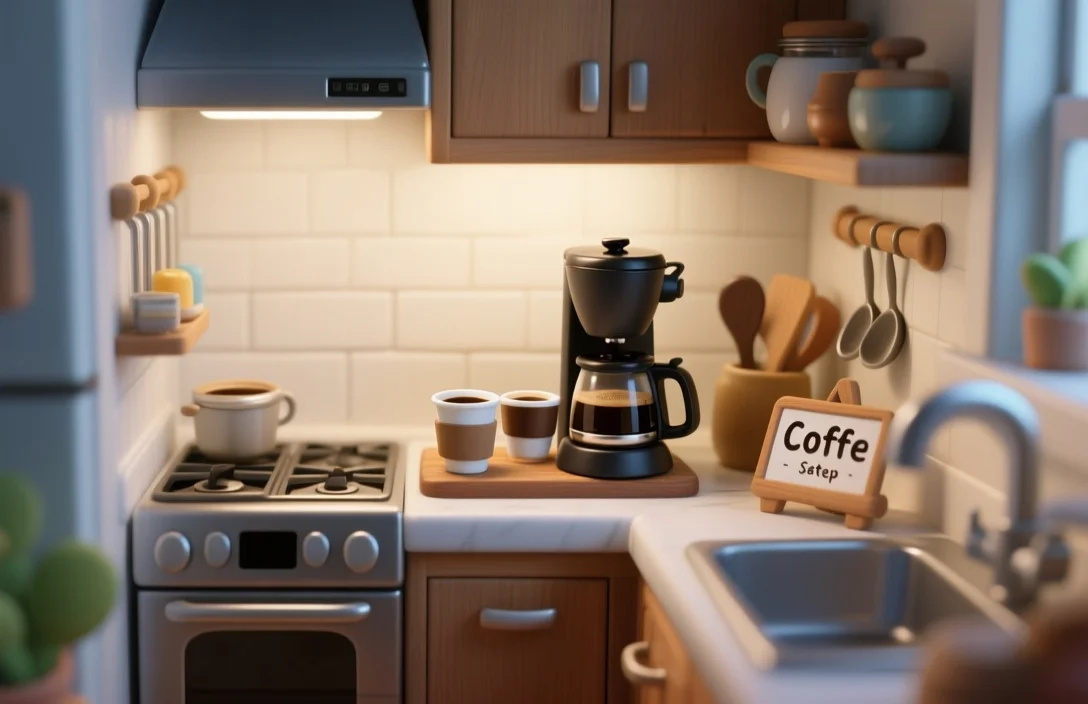
Tiny kitchen coffee setup is absolutely doable. If you keep the station small, pick one main brew method, and stay honest about how much counter space you actually have, you can make good coffee without turning the kitchen into a storage problem. The trick is to buy for your routine, not for an imagined future setup.
What a tiny kitchen coffee setup really is
A tiny kitchen coffee setup is a compact arrangement of equipment, storage, and workflow that fits limited counter and cabinet space while still making coffee you want to drink every day. I would think about it less as a collection of coffee gear and more as a small system. Every item should earn its place.
That usually means one clear path from water to cup, with as little backtracking as possible. It also means putting storage where you will actually use it, instead of spreading filters, beans, mugs, and tools across three different cabinets.
How to decide what matters most
Before buying anything, decide what you care about most. Speed, taste, simplicity, variety, and cleanup do not always point to the same gear.
My practical rule is to choose one main priority and one secondary priority. For example:
- Daily black coffee in under 5 minutes
- Espresso-style drinks a few times a week
- Minimal cleanup
- The smallest possible footprint
- A little more control over brewing
That decision shapes everything else. If you want speed, a pod machine or compact drip maker makes sense. If you want more flavor control, a manual brewer and a small grinder usually fit better. If cleanup matters most, I would keep the system very simple.
Measure the space too. Not just the counter width, but the depth, the cabinet clearance above it, and the outlet location. In a small kitchen, those details matter as much as the brewer itself. A machine that technically fits can still be awkward if you cannot lift the lid, pour water cleanly, or remove the carafe without pulling the whole setup forward.
Equipment choices that make sense in small spaces
In a tiny kitchen, each coffee tool has to justify its footprint. That is why compact brewers tend to work better than large all-in-one machines.
Here is the basic trade-off:
- Manual brewers are small and simple, but they ask for more attention
- Pod machines are fast and easy, but they limit flexibility and can cost more per cup
- Compact drip machines are practical for households that want several cups
- Moka pots and manual espresso devices give a stronger cup without a large espresso machine
- Small grinders improve flavor, but they add another item to store
Common compact options
| Name | Price/Key Spec | Best For |
|---|---|---|
| Pour-over cone (paper or reusable) | Low footprint; no electronics | Coffee drinkers who want control and minimal clutter |
| Aeropress | Small, light, easy to store | Single-cup brewing with quick cleanup |
| Stovetop moka pot | Compact metal body; stovetop heat | Strong, espresso-style coffee without a pump machine |
| Single-serve pod machine | Small counter footprint; fast | Quick mornings and very low cleanup |
| Compact drip coffee maker | Small carafe; basic brew programming | Households that want several cups with little effort |
| Portable manual espresso device | Small, manual operation | Occasional espresso-style drinks in a tight space |
| Blade or small burr grinder | Compact size; burr models give more control | Fresh-ground coffee when cabinet or counter space is limited |
If you can only make room for one upgrade, I would usually pick the grinder before the brewer. Whole beans stay fresher than preground coffee, and even a small burr grinder can make a noticeable difference. A hand grinder is a good option if you want to keep the counter clear. An electric grinder is easier day to day, but it adds noise and takes up more room.
How to lay out the station so it works every morning
A small coffee setup works best when it follows one simple route. Water source, kettle or machine, grinder, brewer, cup. If you are constantly crossing the kitchen to get the next item, the setup is too scattered.
I would try to keep the main brewing zone within a narrow stretch of counter, even if that means moving a few less-used items elsewhere. Twelve to twenty-four inches of linear space can be enough for a compact routine if the layout is clean.
A few layout choices matter more than people expect:
- Keep the grinder near the brewer if you grind fresh
- Put mugs where they are easy to reach, not buried behind plates
- Store beans close to the station but away from heat and sunlight
- Leave a small landing area for a hot carafe or cup
- Keep cords short and away from the sink
Vertical space helps a lot in tiny kitchens. A slim shelf above the station can hold beans, filters, and spare mugs. Hooks under a cabinet can free up counter space. A narrow cart can function as a dedicated coffee spot if you do not have enough room on the counter itself.
Storage that does not eat the whole kitchen
Storage is where tiny coffee setups usually fall apart. The issue is not lack of space in the abstract. It is that small items spread out quickly and make the whole kitchen feel crowded.
I would start with airtight storage for beans. Keep them in an opaque container near the coffee station, but not right next to the stove or in direct light. After that, organize the small pieces that tend to disappear, like filters, scoops, brushes, and reusable parts.
Useful storage pieces include:
- Airtight bean canister
- Reusable filter or flat-stored paper filters
- Small kettle with a cord wrap
- One grinder, either compact electric or hand-crank
- Stackable mugs or cups
- Microfiber cloths
- Small brush for grounds
- A narrow cart or shelf, if needed
Drawer storage is often better than people think. A shallow tray can keep filters, tools, and spare parts from floating around the kitchen. If you have a cabinet door near the station, use the inside of it for hooks or small racks if the hardware is light enough. I would avoid bulky glass canisters unless you have a lot of room. They take up more space than they seem to on the shelf.
Brewing methods that work well when space is tight
A tiny kitchen usually rewards consistency more than complexity. A simple method, repeated well, is better than a crowded counter full of gear you rarely use.
A digital scale is worth the drawer space if you want repeatable results. It helps more than most people expect.
Pour-over
Pour-over is a strong choice if you want control without much equipment. A cone, filter, kettle, and scale are enough. A gooseneck kettle helps with pouring, but you do not need a giant setup.
A basic starting point is a coffee-to-water ratio around 1:15 to 1:17. Use a bloom pour first, then continue with slow pours so the grounds extract evenly. This method is compact, but it does ask for a little attention.
Aeropress
The Aeropress is one of the easiest fits for a small kitchen. It is compact, simple to store, and fast to clean. It also does not require much counter space.
For a single cup, 14 to 18 grams of coffee is a reasonable starting point. You can adjust water and grind to taste. I would keep this one in mind if you want a brewer that disappears into a drawer when you are done.
Moka pot
A moka pot is a good middle ground if you want strong coffee without buying an espresso machine. It does need a stove, so it is not a fit for every tiny kitchen, but the footprint is small.
It is not espresso in the strict sense, and I would not oversell it that way. It makes a strong, concentrated cup that works well for people who want something richer than drip coffee.
Compact drip machine
If you brew for two people or want several cups at once, a small drip machine may be the most practical choice. It is less flexible than manual methods, but it is easy to live with.
The main thing I would watch is size. Some machines are compact in theory but still awkward in practice because the lid opens high or the carafe handle sticks out farther than expected.
Manual espresso devices
These are worth considering if you want espresso-style drinks and do not have room for a full machine. They are small, but they usually ask for more effort and more consistency from the user.
I would treat them as a niche choice, not a default recommendation. They make sense if espresso is a real habit, not an occasional curiosity.
A few setup ideas for common tiny kitchens
Different kitchens need different answers. There is no single layout that works for everyone.
For one person who wants fast mornings
A pod machine or an Aeropress plus a small kettle is usually enough. Keep the machine or brewer on the counter, store the rest in a drawer, and use a small mat under the setup to catch drips.
For two people who drink several cups a day
A compact drip maker with a thermal carafe is often the easiest answer. Add a small burr grinder if fresh beans matter to you. Keep filters, sugar, and spoons in one nearby drawer or tray so the station stays contained.
For a tiny house or RV
Portable gear usually wins. A moka pot, manual grinder, and compact kettle can cover a lot of ground without taking over the space. If you move things often, non-slip mats and secure storage matter more than they do in a standard kitchen.
For a dorm room or micro-studio without a stove
An Aeropress and an electric kettle with automatic shutoff are practical choices. They are small, easy to store, and do not require much cleanup. I would keep the routine simple here and avoid buying extra accessories that will only sit around.
For a shared apartment kitchen
A narrow cart or a clearly marked shelf can keep the coffee station from becoming a source of friction. Label shared items, keep personal supplies in a separate bin, and make it obvious what belongs where. Shared kitchens need rules more than they need more equipment.
Cleaning habits that keep the setup livable
In a tiny kitchen, cleanup matters more because residue and odors build up faster in a small area. Coffee oils, wet grounds, and drips can make the whole space feel messy even when the actual clutter is minor.
I would keep the daily routine short:
- Rinse the brewer right after use
- Empty grounds promptly
- Wipe the counter before leaving the kitchen
- Let reusable parts dry fully before putting them away
That simple routine keeps problems from piling up. A small drying mat under the sink or in a cabinet can help if you do not have space on the counter.
For deeper cleaning, follow the manufacturer’s guidance for your machine. Drip makers, grinders, and espresso devices all have different needs. Keep a brush, microfiber cloth, and cleaning solution together so you are not hunting for supplies every time.
What I would skip in a tiny kitchen
This is where judgment matters. A lot of coffee gear looks appealing until it sits on a small counter for a week.
I would skip:
- Full-size machines made for large households
- Multiple single-purpose tools that do nearly the same job
- Decorative containers that take up too much space
- Extra mugs and accessories you rarely use
- Large grinders if you are not grinding often
- A full espresso setup if you only make espresso-style drinks occasionally
The better approach is usually one brewer, one storage system, and maybe one grinder. That is enough for most people. More than that, and the setup starts competing with the rest of the kitchen.
A sensible way to shop
When you shop for coffee gear in a small kitchen, bring measurements with you. Do not rely on product photos or model names. Check width, depth, height, and how much room the lid or handle needs when in use.
I would also look at return policies before buying anything online. A product can be technically compact and still feel too large once it sits on the counter. If possible, compare a few options in person so you can judge scale with your own eyes.
For grinders, burr design matters more than branding. A compact burr grinder usually gives better results than a blade grinder, even if it takes up a little more room.
FAQ
How much counter space do I need?
A compact coffee setup can work in about 12 to 24 inches of linear counter space, plus a little room for staging. The exact amount depends on whether you keep the grinder, kettle, and brewer out at the same time.
Can I make good coffee without a grinder?
Yes. Preground coffee can still be decent if you store it properly and use it quickly. Fresh grinding usually tastes better, though, so a small hand grinder is worth considering if flavor matters to you.
Is electric or stovetop better for a tiny kitchen?
It depends on your routine and what utilities you have. Electric devices are usually more convenient. Stovetop options are often smaller and easier to move around. I would choose based on the way you actually make coffee, not on a general idea of what is best.
How should I store beans?
Use an airtight, opaque container and keep it away from heat and sunlight. Buy only what you will use fairly soon so the beans do not sit around too long.
Is a cart worth it?
Yes, if you do not have enough counter space. A narrow wheeled cart can act like a small coffee station and move out of the way when you need the surface for cooking. Just keep the footprint modest.
How often should I clean the grinder?
Brush out loose grounds often and do a deeper clean regularly. For light use, every few weeks may be enough. For daily use, weekly maintenance is more sensible.
A tiny kitchen coffee setup works best when it is plain, compact, and easy to repeat. Start with the coffee you actually drink, measure the space you have, and choose the smallest set of tools that supports that routine. If you do that, the setup stays useful instead of turning into clutter.

- Espresso Tastes Watery? 10 Common Causes and How to Fix It - October 23, 2026
- 10 Common Coffee Equipment Cleaning Mistakes and How to Avoid Them - October 23, 2026
- 17 Common Coffee Grinder Problems and How to Fix Them - October 23, 2026