
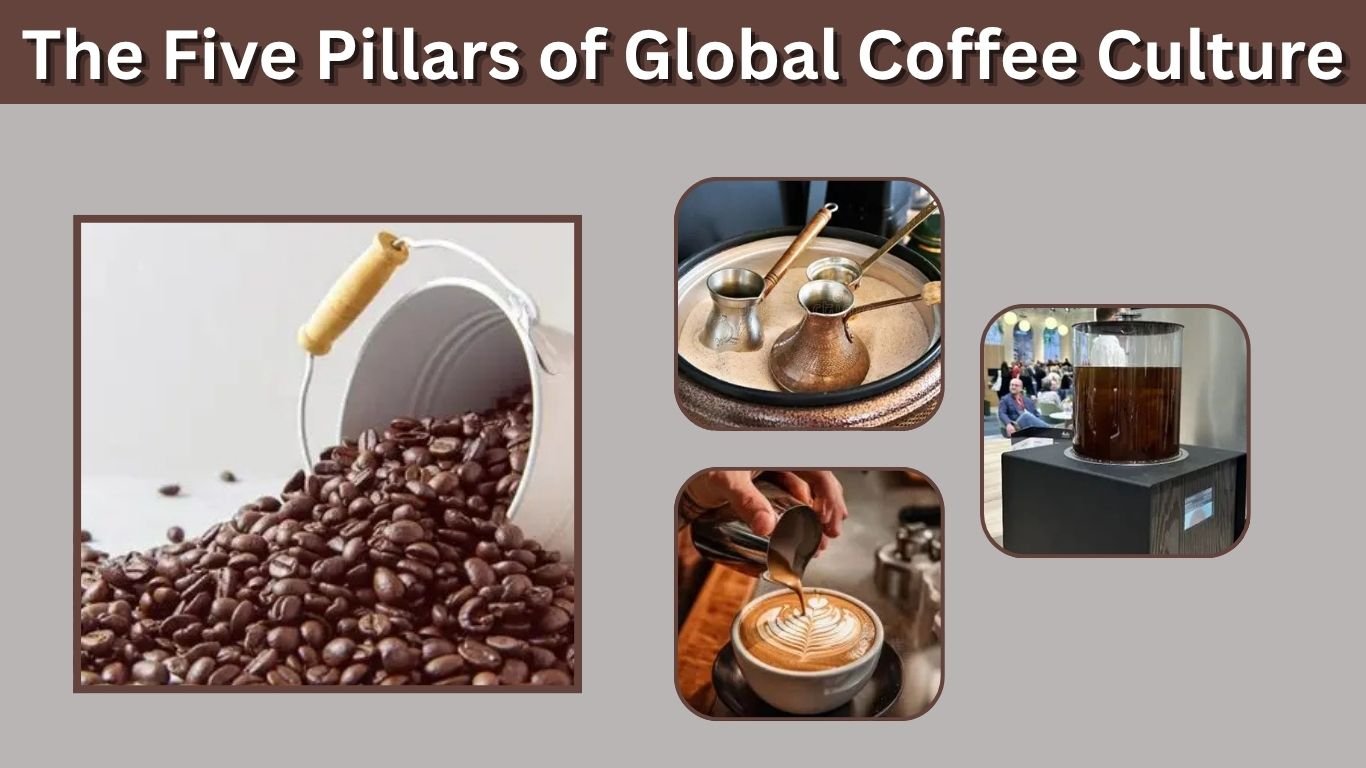
Coffee is far more than a morning stimulant. It is a global language, a ritual, and for millions, a daily act of precision and passion. Over the centuries, distinct preparations have emerged, each capturing a different philosophy of extraction, texture, and taste. Some are built on speed and pressure, others on patience and gravity. Some honor the raw, gritty heritage of the bean, while others celebrate the silky alchemy of perfectly steamed milk.
To truly understand coffee is to appreciate not just the drink in your cup, but the lineage and the technique that shaped it. This guide dissects five iconic pillars of the coffee world: the concentrated intensity of Espresso, the balanced architecture of the Cappuccino, the smooth patience of Cold Brew, the ancient ritual of Turkish Coffee, and the modern velvet of the Flat White. We will explore what makes each one unique, how they are constructed, and the invisible threads that connect them all. Consider this your deep dive into the craft.
A Connoisseur’s Framework for Understanding Coffee
Before we pull a shot or steam a pitcher of milk, it helps to establish a working vocabulary. Every coffee preparation, no matter how simple or complex, is the result of manipulating a handful of fundamental variables. Think of these as the controls on an instrument panel. The final flavor, aroma, and mouthfeel are the music you create by adjusting them.
The Fundamental Variables
- Origins and Terroir: The coffee bean is an agricultural product. Its inherent flavor fingerprint is determined by where it’s grown—the altitude, soil composition, and climate of places like Ethiopia’s Yirgacheffe region, the volcanic slopes of Guatemala, or the islands of Sumatra.
- The Roast Spectrum: The transformation of a dense, green seed into a brittle, aromatic bean is controlled by time and heat. A light roast preserves floral and fruity acidity. A medium roast develops balance and caramel sweetness. A dark roast pushes past acidity into bold, bitter, and smoky territory, where the roast character often dominates the origin.
- The Physics of the Grind: Particle size is the primary control for extraction speed. A coarse grind, with the texture of sea salt, releases its flavors slowly, making it ideal for immersion methods. An extra-fine grind, like powdered sugar, offers massive surface area and immediate resistance to water flow, essential for high-pressure espresso. The consistency of this grind, achieved through a burr grinder, is non-negotiable.
- Extraction Dynamics: Brewing is the act of using water as a solvent to pull soluble compounds from the coffee. How you do this—through pressure, immersion, or gravity—dictates the result. The water temperature, its mineral content, and the contact time all determine which flavors are extracted and which are left behind.
- The Role of Milk and Texture: In a significant portion of the coffee spectrum, milk is not an additive but a core ingredient. Its temperature, volume, and, most critically, the way air is introduced into it, defines the texture of the final drink, from the dense, dry foam of a classic cappuccino to the integrated, liquid silk of a flat white.
A Deep Dive into the Five Iconic Coffees

1. Espresso — The Concentrated Foundation
Espresso is not a type of bean or a specific roast. It is a brewing method, and it is the starting line for a vast family of drinks. The word itself is Italian for “expressed” or “pressed out,” which perfectly describes the process: nearly boiling water is forced through a compact bed of finely-ground coffee at intense pressure, typically around nine bars.
The goal in 25 to 30 seconds is to achieve a complete emulsification of coffee oils, soluble gases, and aromatic compounds into a small, dense demitasse of liquid. A well-executed shot has a visual and aromatic anatomy. The bottom is the heart, a deep, dark brown base delivering bitterness and body. The middle, the body, is a caramel-colored layer that carries the sweetness and balance. The top is the crema, a reddish-golden foam composed of carbon dioxide and lipids. This crema is the hallmark of a fresh, correctly extracted espresso, serving as a fragrant lid that traps the volatile aromatics directly under the drinker’s nose.
Achieving this requires dialing in several variables: the dose of coffee, the fineness of the grind, the stability of the water temperature, and the evenness of the tamp that compacts the grounds. If any of these are off, the result is a thin, sour, or harsh shot. The espresso is the fundamental building block, the atom of the specialty coffee world, upon which the architecture of milk drinks is constructed.
2. Cappuccino — The Textured Tripartition
The cappuccino is an Italian masterpiece of balance, defined not by a single flavor but by a strict structural ratio. Historically, its name is said to derive from the color of the robes worn by the Capuchin friars, a hue mirrored in the perfect marriage of coffee and milk. The classic cappuccino is a drink of thirds: one part espresso, one part steamed milk, and one part milk foam.
This is not a haphazard construction. The espresso is poured first, providing the bitter, foundational warmth. Next comes the steamed milk, a silky liquid that adds sweetness and dilutes the coffee’s intensity just enough. Finally, the foam is spooned on top, forming a thick, insulating, domed cap. This dry, aerated foam serves a distinct purpose. It physically separates the drinker’s lips from the hot liquid below, allowing the first sensory experience to be the aroma of the coffee filtering through the foam’s air pockets.
The drinking experience is a journey. You first encounter the dry, airy texture of the foam, then a wash of the warm, sweet milk, and finally the deep, bitter resonance of the espresso at the finish. This layered separation is the cappuccino’s defining character, distinguishing it sharply from its more homogenized counterparts where the foam, milk, and coffee are combined. The ideal temperature of the final drink hovers around 67°C, an immediate, comfortable equilibrium created by mixing the near-boiling espresso and the slightly cooler steamed milk.
3. Cold Brew — The Temporal Extract
Cold brew is a testament to the power of patience. It’s a method that entirely rejects heat as an extraction catalyst, substituting it with time. Instead of using thermal energy to violently strip compounds from the bean in seconds or minutes, cold brew relies on a gentle, prolonged immersion in cool or room-temperature water, typically for 12 to 24 hours.
The process begins with a very coarse grind, resembling raw sugar or coarse sea salt. This coarse texture is critical; if the coffee is ground too fine, the prolonged contact time will result in a muddy, overwhelmingly bitter, and over-extracted sludge. The grounds are saturated and left to steep, during which time the water slowly performs its work, preferentially dissolving sugars, chocolaty notes, and lighter molecular compounds while leaving behind many of the sharper acids and bitter tannins that hot water extracts so readily.
The result is a chemical and sensory profile that is immediately recognizable. The acidity is mellowed and smooth, lacking the bright, tangy bite of a hot-brewed coffee. The body is heavy and almost syrupy. Because the brew ratio uses a high dose of coffee to a small amount of water, the finished product is often a shelf-stable concentrate. This concentrate can be diluted with water or milk, creating a remarkably consistent and smooth beverage. Its oxidation rate is slower than that of hot coffee, meaning a batch can maintain its flavor integrity in a refrigerator for up to two weeks, making it a monument to convenience and smoothness. Its caffeine content, a common point of curiosity, is potent due to the high concentration, requiring careful dilution for a standard serving.
4. Turkish Coffee — The Unfiltered Ancestor
Turkish coffee represents the deepest roots of our collective coffee culture, a method recognized by UNESCO as an Intangible Cultural Heritage. This is an ancient preparation, unfiltered and unapologetic, that offers a window into the coffee rituals of the Levant, the Balkans, and the Middle East. The process defies modern filtration logic. The beans are pulverized into a powder so fine it resembles talcum, a grind finer than anything an espresso machine could handle.
This coffee dust is combined with cold water and often sugar in a small, long-handled pot with a wide base and narrow neck, traditionally made of copper or brass and called an ibrik or cezve. The pot is placed over a heat source, traditionally hot sand for uniform temperature distribution, and heated slowly. The goal is not to boil the coffee violently but to coax it into a controlled ascent, creating a thick, dark foam, the kaimaki, which is a prized sign of a correctly made cup. The mixture is brought to the verge of boiling and often removed and returned to the heat several times to build this foam.
The final product is poured into a small, demitasse-style cup, grounds and all. You do not drink it immediately. First, a glass of water is served to cleanse the palate, establishing a ritualistic sequence. Then, you sip the coffee, waiting for the fine powder to settle into a thick sludge, the telve, at the bottom. This sludge is not merely waste; it is the canvas for tasseography—the art of fortune-telling by reading the patterns left in the cup. The experience is often accompanied by the aromatic, sweet scent of cardamom, a spice that is frequently ground and brewed alongside the coffee, binding metabolically to create a unique, perfumed profile that balances the intense, dark roast.
5. Flat White — The Velvet Antipodean Export
The flat white is the modern icon of precision milk coffee, a drink born in the 1980s from the competitive coffee scenes of Australia and New Zealand. Its name is a direct declaration of rebellion against the oversized, foam-heavy cappuccinos and lattes of a previous era. The “flat” refers not to the drink’s flavor but to the denial of a stiff, dry, spooned-on foam cap. There is no domed meringue here. Instead, there is only a thin layer of liquid velvet: micro-foam.
The magic of the flat white begins with a different coffee base. Instead of a standard espresso shot, it typically uses a double ristretto. A ristretto is a “restricted” pull of espresso, using the same amount of coffee but roughly half the water, extracted in a shorter time. This isolates the sweetest, most syrupy, caramel-heavy compounds of the bean while leaving behind the more bitter, tannic elements that come later in a full extraction. This dense, intensely sweet coffee base is the engine of the drink.
Into this, perfectly stretched milk is poured. The technique involves introducing just enough air to create a seamless, glossy texture with barely visible bubbles, then continuing to steam and whirlpool the milk to break any visible bubbles down completely. The result is a milk that pours like wet paint and mixes homogeneously with the espresso as it’s poured, creating an integrated flavor from top to bottom. Served in a smaller ceramic cup, typically around 165-200ml, the flat white offers a strong, resonant coffee flavor that is not diluted by excessive liquid milk, blanketed in a purely silky texture. The barista’s pour usually creates a pattern of latte art, an aesthetic signature on a drink defined by its seamless unity.
How the Five Coffees Compare
A comparative overview of their core construction and character.
| Coffee | The Base | The Milk Texture | The Time Factor | The Grind | The Dominant Character |
|---|---|---|---|---|---|
| Espresso | It is the base | None used | 25-30 seconds | Extra Fine | Intense, Syrupy |
| Cappuccino | A single espresso shot | Thick, Dry Foam Cap | ~40 seconds to prep | Extra Fine | Balanced, Layered, Airy |
| Cold Brew | A concentrate from immersion | None (optional in serving) | 12-24 hours | Medium-Coarse | Smooth, Chocolaty, Muted Acidity |
| Turkish Coffee | A decoction from an ibrik | None used | 2-3 minutes on heat | Ultra-Fine Powder | Gritty, Bold, Often Spiced |
| Flat White | A double ristretto | Thin, Integrated Micro-foam | ~35 seconds to prep | Extra Fine | Velvety, Intensely Sweet |
The Invisible Connections That Define a Coffee

To truly navigate a coffee menu or perfect a recipe at home, one must understand not just the drinks in isolation, but their relationships to one another. They are a family of solutions, linked by shared techniques and divergent paths.
The Lineage of the Cappuccino
The cappuccino cannot exist without the espresso. It is a dependent creation. The espresso provides the foundational bitterness and volume, onto which the structure of steamed milk and foam is built. The relationship is one of architecture. If you remove the single shot of espresso from the equation, the drink ceases to be a cappuccino and becomes simply a cup of textured milk. They are linked by a parent-child connection in the coffee lineage.
A Thermal Divide
The espresso and cold brew represent opposite poles of energy transfer. The espresso is a violent, high-temperature, high-pressure event that strips the bean of its compounds in half a minute, creating a sharp, dynamic profile alive with acids and aromatics. The cold brew is a passive, low-energy, multi-hour diffusion that gently persuades the bean to release its sugars and deeper notes while leaving its volatile, sharp edges behind. They are defined by their thermal opposition; one is a sprint, the other a meditation.
The Bookends of Texture
Turkish coffee and a flat white are the ultimate opposites in mouthfeel, representing the two extremes of the filtration spectrum. Turkish coffee is an unfiltered suspension. The coffee grounds are pulverized into a dust that never leaves the liquid, creating a thick, chewy, and undeniably gritty texture that coats the palate. The flat white, in contrast, is a meticulously double-filtered, polished emulsion. The grinds are completely removed by the espresso portafilter, and the only added texture is a homogenized, fat-smooth milk. To drink them back-to-back is to experience the full textural range of what coffee can be, from primordial sludge to modern silk.
Rethinking Concentrates
It’s a common mistake to classify a strong espresso shot as a concentrate in the same way cold brew is. They serve different roles in the coffee ecosystem. A cold brew is made at a ratio intentionally potent for the purpose of later dilution. It is a true volumetric concentrate designed to be mixed. An espresso, while intense, is a finished culinary endpoint. It is meant to be drunk as it flows, a complete beverage in a small cup. When you dilute it with hot water, you don’t just have a weaker espresso; you have created a different drink entirely, an Americano. The action of dilution transforms the entity.
Answering Common Questions from a Connoisseur’s Lens
Which of these five coffees packs the biggest caffeine punch?
This is a question of dose versus concentration. If you were to analyze it milliliter by milliliter, the espresso shot is the most concentrated source, roughly 63 milligrams in a tiny 30ml volume. However, in a real-world, full serving, a large, undiluted cold brew concentrate takes the title. A full immersion brew with a high coffee-to-water ratio can easily deliver over 250 milligrams in a 16-ounce serving, making it the quiet powerhouse.
Why can’t I just grind beans to dust for my Turkish coffee?
The grind for Turkish coffee is non-negotiable. You need a specific, ultra-fine powder, a physical state finer than even espresso. Standard home burr grinders are physically incapable of achieving this without overheating the motor and damaging the burrs. The entire ritual—the rising of the foam, the suspension of the grounds, the mouthfeel—depends on a particle size that behaves more like dust than grain. A grind that is merely “very fine” will sink instantly and fail to produce the prized kaimaki foam.
Why is a flat white not just a small latte, and why can’t I make a cappuccino with cold brew?
A flat white and a latte are differentiated by two critical details. The flat white uses a ristretto base, which is sweeter and more concentrated than a standard latte’s espresso shot. More importantly, the milk texturing is fundamentally different. A latte has a layer of liquid steamed milk under a thin cap of foam. A flat white’s micro-foam is uniformly integrated, creating a single, velvety texture throughout. The separation is missing. As for a cold brew cappuccino, the term is a contradiction. A cappuccino is defined by the act of steaming milk, which requires heat to denature proteins and physically stretch the air bubbles. Pouring cold milk over cold brew creates a perfectly fine iced coffee, but you cannot create a thermal foam structure without heat; the drink has a different identity.
Expanding Your Knowledge Map
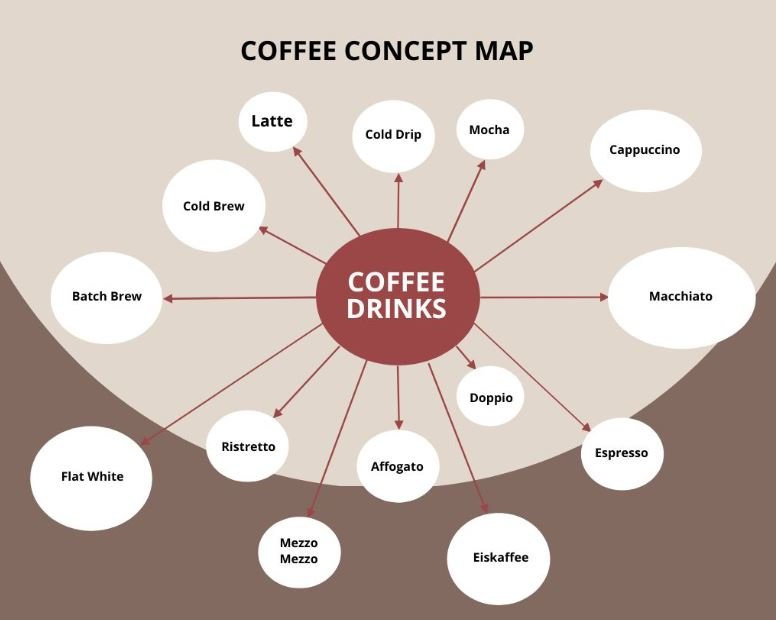
A true coffee education never stops. Beyond these five pillars, understanding a few more points on the landscape will deepen your appreciation.
- The Moka Pot Illusion: The stovetop moka pot is often mistaken for a home espresso maker. It does use steam pressure, but only about 1.5 bars, a fraction of what an espresso machine produces. It creates a strong, dense, and delicious coffee, but it cannot generate the high-pressure emulsification required for true crema. It’s a distinct category of its own, a pressurized percolation.
- A Close Sibling: The Cortado: The cortado, from Spain, is a close relative of the flat white, but with a different philosophy. It uses a standard espresso shot and an equal amount of lightly textured, very hot milk. Its purpose is not to create a silky volume but to cut the acidity of the espresso with a minimal amount of milk, preserving the pure coffee intensity in a way a larger flat white does not.
- The Sweet Heart of the Flat White: The ristretto base we discussed is a secret weapon. By only extracting the first, most soluble part of the shot, you are isolating the sugars and caramels and physically preventing the later-extracting, harsher bitter compounds from ever entering the cup. It is a controlled sacrifice of volume for a gain in pure sweetness.
- The Modern Evolution of Cold Brew: Nitrogen-infused cold brew is the next logical step. By injecting nitrogen gas into the liquid and pouring it through a stout faucet, the mouthfeel is transformed again, creating a cascading, creamy head and a texture that mimics a fine draft stout, all without adding a single calorie from dairy or sugar.
The world of coffee, as seen through these five preparations, is a masterclass in control. From the urgent, 30-second explosion of espresso to the overnight patience of cold brew, from the unfiltered history in an ibrik to the precise, silky integration of a flat white, each cup tells a story of how time, heat, and texture intersect. Understanding these connections doesn’t just make you a better barista; it makes every sip a more profound experience.

- Unlocking the Venti: Discover the Perfect Shot Count for Your Drink - October 13, 2026
- Unpacking the Buzz: Caffeine Levels in Café Bustelo Espresso - October 13, 2026
- How to Fix Bitter Coffee: 10 Expert Ways to Improve the Taste - October 4, 2026