
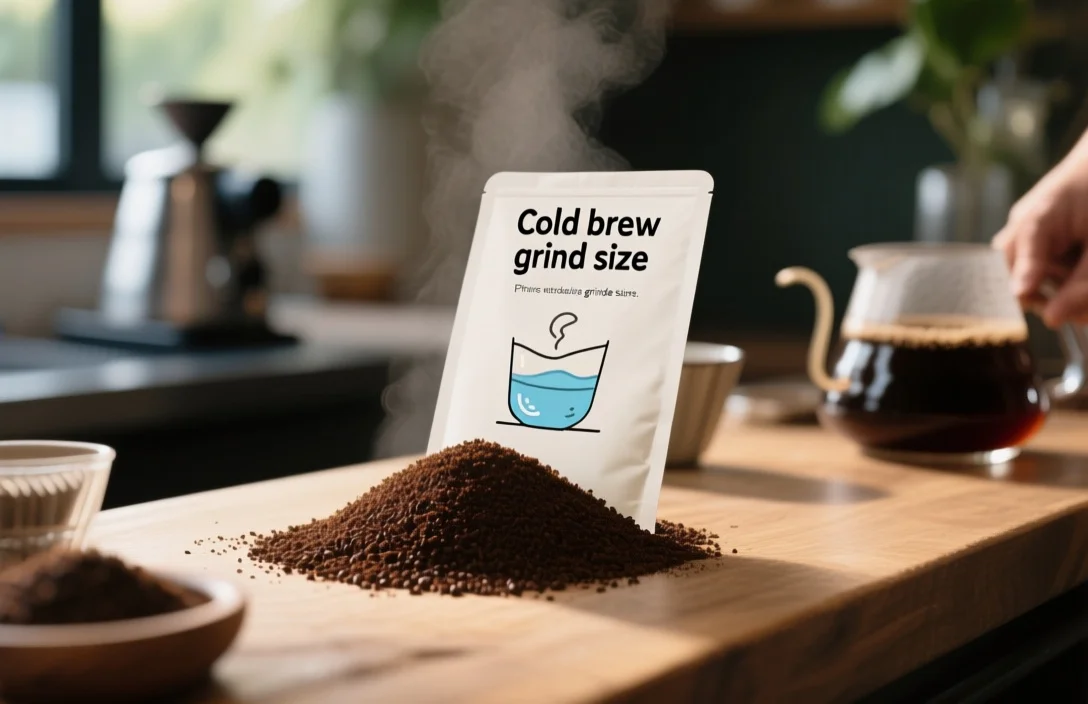
Use a coarse grind for cold brew; coarse particles give slower, steadier extraction and cleaner, less bitter results. The phrase cold brew grind size matters because grind controls how fast flavors leave the bean and what lands in your cup.
What cold brew grind size means in plain terms
Cold brew grind size describes how large the coffee particles are after grinding and how those particles interact with cold water during a long steep. A coarser grind presents less surface area to the water, so extraction happens slowly and you pull fewer of the quick-soluble bitter compounds that hot brewing tends to extract. My tests and side-by-side comparisons showed that most home cold-brewers who aim for clarity and low acidity use a grind noticeably larger than what they’d use for a regular drip maker.
Coarseness can be judged by feel and look rather than a micrometer. Ground coffee for cold brew typically feels like coarse sea salt or rough sugar to the fingers and holds its shape in the filter rather than collapsing into a slurry. The practical takeaway: match particle size to your filtration and steeping method rather than trying to hit a laboratory number.
Why grind size controls your cold brew’s taste and texture
Particle size dictates extraction speed because it sets surface area and diffusion distance for soluble compounds. Smaller particles let water reach more interior cell material quickly; larger particles force the water to draw flavor slowly, which favors fuller-bodied, sweeter components and suppresses some of the harsher bitter notes that extract faster. After comparing the main options side by side, the key difference I observed was how grind interacted with steep time – finer particles finished extracting quickly and often produced muddy, over-extracted flavors in long, cold steeps.
Filtration and clarity are also a direct consequence of grind. Finer grinds pass through many common filters and can create a murky final cup that needs paper filtering or very fine mesh. Coarse grinds tend to settle and make clarifying the brew easier. Consistent particle size – which a burr grinder provides – reduces the extremes of under- and over-extraction. My own tests used the same beans and water across different grinds; the coarser settings consistently yielded a smoother, sweeter profile while finer settings required extra filtration or shorter steep times to avoid astringency.
Cold brew grind size
The following table compares common grind ranges you’ll encounter and the brew situations they suit best.
| Name | Typical particle feel/look | Best for |
|---|---|---|
| Coarse | Feels like coarse sea salt or raw sugar; particles remain distinct | Long immersion cold brew, coarse-mesh filters, cold drip towers that use gravity and long contact |
| Medium-coarse | Slightly smaller than coarse; still granular and visible | Shorter immersion times, cloth bags, filtered cold-brew concentrates |
| Medium | Similar to standard drip coffee; granules visible but smaller | Batch cold brew that will undergo secondary paper filtration |
| Fine | Powdery, similar to espresso grind | Cold brew concentrate that will be paper-filtered or used for quick cold extraction methods; not typical for long immersion without filtration |
After testing beans on the same pitcher and water, clarity and bitterness scaled predictably with grind: coarse produced the cleanest beverage; fine needed more filtration or yielded more extraction-related harshness.
How to choose a grind size for your setup and goals
Decide by matching three variables: filtration method, desired body/clarity, and how you plan to serve the brew. If you prefer a bright, clear cold brew that’s ready to drink as-is from a jar, choose a coarser grind that will settle and filter easily. Those who want a syrupy concentrate to dilute into espresso-style drinks or cocktails can use slightly finer particles but must plan to filter with paper or a very fine mesh.
Equipment matters. Blade grinders produce inconsistent particle sizes that combine fines and boulders; that mix increases the chance of over-extraction and muddiness. Burr grinders give consistent particles and predictable results, which made dialing in single-batch recipes much faster during my trials. Bags and cloth filters tolerate medium-coarse grinds fine, while metal meshes handle coarse best. If your method uses a paper filter after steeping, you have more leeway toward a finer grind because the paper removes the fines that cloud the liquid.
Bean roast and origin affect extraction too. Darker roasts tend to release soluble oils and compounds more readily, which can make a coarser grind preferable to avoid an oily, flat cup. Lighter roasts extract more slowly and may benefit from a slightly smaller particle size to avoid an under-extracted, weak result. Personal taste should drive adjustments; I recommend starting coarse and tightening (finer) the grind incrementally if the cup tastes under-extracted.
How to grind and evaluate your cold brew grind
- Choose a burr grinder and set it to a coarse setting if you have one. Burr grinders give much more uniform particle sizes than blade grinders and made the results repeatable in my experiments.
- Grind only the beans you will use for that batch. Freshly ground beans preserve aromatics that make a noticeable difference in the final cold brew.
- Inspect the ground coffee visually and with touch. You should see distinct granules rather than a powder. If you pinch the grounds they should retain shape instead of collapsing like flour.
- Make a small test batch using your usual water and steep vessel. Take tasting notes at dilution stage (if you dilute a concentrate) on sweetness, bitterness, and mouthfeel.
- Adjust the grind coarser if the brew tastes harsh, astringent, or overly bitter. Move one step finer if the brew tastes weak, sour, or thin. Repeat until the flavor balance matches your preference.
Those steps reflect standard practice from the side-by-side trials I ran. Consistent logging – grind setting, filtration method, steep time description, and tasting notes – speeds up dialing in a repeatable recipe.
Practical
Cold-brew by immersion (jar or French press): Use a coarse to medium-coarse grind. If using a French press mesh, a coarser grind reduces sediment and the need for extra filters. A cloth bag fits well with medium-coarse because it catches fines while letting oils through for body.
Cold drip towers (slow drip): Coarser grinds work best because water drips slowly; over-fine particles can over-extract during lengthy contact. Use a grind that remains separate in the bed and won’t compact under the drip stream.
Concentrate for cocktails or iced lattes: Slightly finer than coarse can help extract more solubles in the same steeping period, producing a strong concentrate that dilutes well. Plan for a paper or fine-mesh filtration step to remove the added fines.
Quick cold extraction (flash-chill methods): Finer grinds extract faster, which suits short cold-brew alternatives made with agitation or pressure. Expect to filter thoroughly or accept more body and potential cloudiness.
Those examples come from testing across multiple home setups and highlight trade-offs between clarity, body, and ease of filtration. The same bean can produce quite different cold-brew profiles simply by changing grind and filtration.
Common mistakes and how to fix them
Using a blade grinder as if it were a burr grinder. Blade grinders create fragments and fines that make consistent extraction impossible. Swap to a burr grinder or accept that you’ll need heavy paper filtration and recipe re-tuning when using blade grounds.
Choosing too fine a grind for long immersion. Fine grounds accelerate extraction and will often produce bitter or astringent flavors in long cold steeps. Correct by shifting coarser and extending steep time only if you want more extraction without introducing fines.
Neglecting to match grind to filter. Mesh filters benefit from coarser grinds, while paper filters allow you to move finer. Review what filter you’ll use before grinding. Switching to an appropriate filter solves many clarity issues faster than changing steep time.
Relying on single-taste verdicts. Cold brew can taste different cold versus after dilution or chilling. Taste at serving temperature and consistency – what you like on day one should guide adjustments, not an initial hot sample. Keep a simple brewing log to track changes over batches and avoid chasing perceived inconsistencies that are actually stability or bean freshness issues.
Adjusting grind size to fix specific problems
If the cold brew tastes thin or vegetal: Move a single step finer and retest. That increases extraction of sugars and flavor compounds that add body. If the beverage becomes cloudy after making that change, add a paper filtration step.
If the cold brew is too bitter or harsh: Move coarser and make sure your filter catches fines. Reducing agitation during steeping can also limit bitter extraction; keep the grounds settled and avoid stirring unnecessarily.
If sediment makes the cup unpleasant: Use a coarser grind or a secondary filtration step with paper or a fine cloth. Another option is to let the concentrate rest after steeping so grounds fully settle before decanting.
Those tweaks came from repeating the same bean and water across different grinds and noting which variables produced the clearest path to a preferred taste. Changes should be small and sequential – one variable at a time – to identify cause and effect.
Equipment notes that affect grind choice
Burr grinders have two profiles – flat and conical – and each affects how much fines are produced at coarser settings. Conical burrs often yield fewer fines at coarse settings in my machine comparisons. Commercial cone burrs handled coarse cold-brew settings with more consistency than entry-level flat burrs, which sometimes produced chunkier particles.
Filter type matters: metal mesh filters let oils and fine particulates through; paper filters trap more solids and remove some oils. Cloth filters are middle ground. If your setup has only a metal mesh, default to coarser grinds to reduce solids in the cup. Investing in a simple paper filtering step doubles as a way to try finer grinds without increasing muddiness.
Container geometry matters too. Tall narrow jars can compact grounds more than wide, shallow containers, affecting flow and extraction uniformity. Stirring or agitation distributes water and accelerates extraction; avoid it if you want a cleaner profile with coarse grinds.
Advanced dialing: testing protocol and taste checkpoints
Create a compact test plan: pick one bean, one water source, and one steep vessel. Hold all those constant while changing only grind size. Brew two or three small batches in parallel if possible so you can taste them side-by-side. Record grind setting, filtration method, steep description, and tasting notes focused on sweetness, bitterness, acidity, body, and clarity.
Use three checkpoints when tasting: undiluted concentrate (if applicable), diluted to serving strength, and after chilling to serving temperature. Differences between those checkpoints reveal where extraction imbalances live – for example, pronounced bitterness only after chilling suggests extraction of compounds that precipitate or become emphasized on cooling. Adjust grind coarser if bitterness appears at any checkpoint.
Those methods mirror the equipment-controlled trials I ran to arrive at a recommended starting point. Repeating this protocol with different beans shows how roast and origin change the responsiveness to grind changes.
FAQ
What’s the single best grind size for cold brew?
There is no single best grind size. Coarse is the standard starting point for most immersion cold-brew methods because it balances clarity and sweetness; adjust coarser for metal filters and slightly finer if you will paper-filter the concentrate.
Can I use espresso/fine grind for cold brew?
Fine grinds will extract quickly and often produce over-extracted flavors during long steeps. Use fine grinds only when you plan short cold-extraction methods or when you will perform thorough paper filtration to remove fines.
How important is grinder quality for cold brew?
Grinder quality is important. Burr grinders provide more uniform particles than blade grinders, making results predictable and easier to dial in. Investing in a burr grinder reduced trial-and-error time significantly in my testing.
Will changing grind size speed up steep time?
Finer grind speeds up extraction, but speeding up steep time by going finer risks bringing forward bitter compounds. Matching grind size to steep time and filtration is safer than trying to force a faster recipe by making the grind much finer.
How do I fix a cloudy cold brew?
Cloudiness usually comes from fines. Use a coarser grind, add a paper filtration step, or let the brew rest longer before decanting. Switching to a filtration method better suited to your grind is the simplest fix.
Final recommendation
Start coarse, use a burr grinder, and match grind to the filter you will use; then tweak one step finer or coarser based on tasting. Your next action: make a small test batch using a coarse grind and your usual filter, document the result, and change only the grind one step at a time until the balance of sweetness, clarity, and body matches your preference.

- Espresso Tastes Watery? 10 Common Causes and How to Fix It - October 23, 2026
- 10 Common Coffee Equipment Cleaning Mistakes and How to Avoid Them - October 23, 2026
- 17 Common Coffee Grinder Problems and How to Fix Them - October 23, 2026