
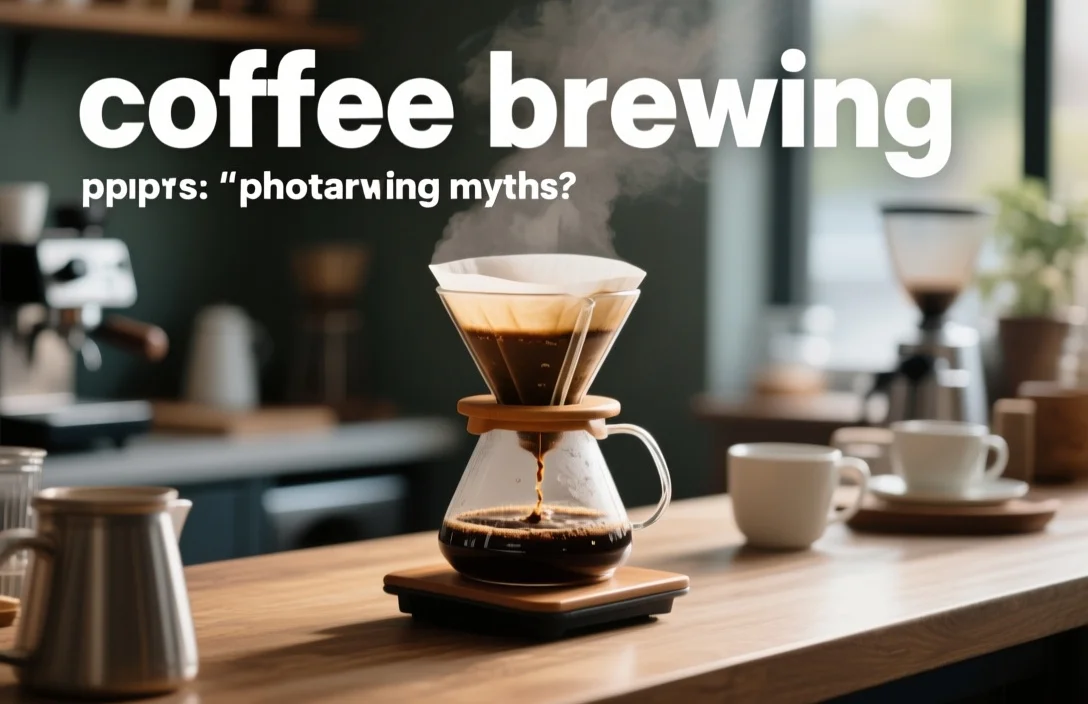
Short answer: many coffee brewing myths mix a real observation with a rushed explanation. Dark roasts can taste stronger without having more caffeine. Boiling water does not automatically ruin coffee. Finer grinds do change extraction, but they do not guarantee a better cup on their own. The useful way to think about coffee is simpler than the myth version: grind size, water temperature, brew time, dose, and filtration all push the cup in different directions.
Which coffee brewing myths are worth ignoring?
The same claims come up again and again. Darker roast means stronger coffee. Finer grind always helps. Boiling water scorches the beans. Espresso is basically just drip coffee in a smaller cup.
I would treat each of those as a partial truth that has been stretched too far. Coffee brewing myths tend to survive because people mix up taste, strength, extraction, and caffeine. Those are related, but they are not the same thing.
A darker roast may taste bolder because roast flavor is louder. A finer grind increases extraction rate, but brew time and dose still matter. Espresso is concentrated, but it is made under a different brewing setup than drip. Once you separate those variables, the myths get easier to sort through.
What actually controls flavor in a brew?
Extraction is the process of dissolving soluble compounds from roasted coffee into water. Some compounds come out early and can taste bright or sweet. Others come later and can taste bitter or drying.
The main variables are grind size, water temperature, brew time, dose, and agitation. Change one of them, and the others may need to shift too if you want the same result. That is where a lot of home brewing confusion starts. People change the grind, keep everything else fixed, then blame the method when the cup tastes off.
My practical rule is to think in pairs. Grind and time work together. Dose and water volume work together. Temperature changes how quickly extraction happens. If you want repeatable coffee, you need to keep those relationships in view.
The grind size myth
Claim: finer grind always makes stronger coffee.
Not really. Finer grind does increase surface area, so water can pull flavor out faster. But if the brew time is too short, or the dose is too low, the cup may still taste weak or thin. The grind is one variable, not the whole recipe.
Claim: coarser grind always makes weaker coffee.
That is too neat as well. A coarse grind can still make a strong cup if the brew time is long enough or the dose is high enough. In immersion methods, for example, a coarse grind may still extract plenty because the coffee stays in contact with water for a while.
I keep coming back to this point because it is the source of many bad brew adjustments. If the cup tastes sour, people often assume the grind is wrong. Sometimes it is. Sometimes the real issue is dose or brew time.
Does longer brew time always mean better coffee?
Claim: longer brew time always makes stronger coffee.
Longer contact time usually increases extraction, but only up to a point. After that, bitterness and dryness start to take over, and the cup can taste flatter rather than richer. Strength in the cup is not the same thing as balance.
That is why a longer brew is not a universal fix. It may help if the coffee tastes thin or sour. It may hurt if the cup is already leaning bitter. The better question is what you want the brew to taste like, then adjust time only enough to move in that direction.
Water temperature, boiling water, and the overblown fear of heat
Claim: boiling water ruins coffee.
That is too absolute. Hotter water extracts faster because heat changes solubility and diffusion. In practice, boiling water can make a cup taste harsher if the grind is too fine or the brew time is too long. But the water itself is not the villain.
For most hot-brew methods, water just below a rolling boil is a practical starting point. If the coffee tastes sharp, sour, or underdeveloped, a little more heat can help. If it tastes bitter or hollow, reduce temperature, shorten brew time, or coarsen the grind.
Claim: room-temperature water is always better for some coffees.
That is really a different brewing style, not a better version of hot coffee. Cold brew uses low temperature and long contact time, so it pulls a different set of compounds and usually tastes less sharp. That makes it useful for some drinkers and some beans. It does not make cold brew the default answer.
Freshness, roast level, and caffeine
Claim: freshly roasted beans always make stronger coffee.
Fresh beans matter, but mostly for aroma and how the coffee blooms during brewing. Roasted coffee releases carbon dioxide after roasting, and that gas can affect even extraction. Too fresh, and some brews can behave unevenly. That is a brewing issue, not a simple strength issue.
Claim: darker roasts have more caffeine.
This one hangs around because darker roasts often taste fuller and more assertive. But that is flavor, not proof of higher caffeine. Roast changes bean mass and flavor compounds far more than it changes caffeine in a dramatic way. In ordinary home brewing, dose and extraction matter much more than roast color if you are trying to control strength.
Storage matters too. Oxygen, light, heat, and moisture all wear coffee down. I would keep beans in a cool, dark, airtight container and stop expecting exact freshness rules to apply the same way to every roast and package.
Equipment myths that get too much credit
Claim: expensive machines automatically make better coffee.
They do not. Better equipment can help with temperature stability, consistency, or convenience. But good coffee still depends on the recipe and the grinder, plus a little attention to measurement. A costly machine cannot fix a badly dialed-in brew.
Claim: paper filters remove all the flavor.
They do change the cup, but they do not erase flavor. Paper filters remove more oils and fine particles, which gives a cleaner body and a different mouthfeel. Metal filters let more oils through, so the cup feels fuller and often heavier. That is a trade-off, not a ranking.
| Name | Price/Key Spec | Best For |
|---|---|---|
| Drip coffee maker | Price/Key Spec: inexpensive to mid; automatic temperature control varies by model | Best For: consistent daily batch with minimal effort |
| French press | Price/Key Spec: low to mid; immersion, metal mesh filter | Best For: fuller body and oil-forward mouthfeel |
| Pour-over (V60, BeeHouse) | Price/Key Spec: low to mid; paper-filtered, manual pour control | Best For: clean clarity and control over bloom/flow |
| Espresso machine | Price/Key Spec: mid to high; high pressure, small-volume extraction | Best For: concentrated drinks and milk-based beverages |
| AeroPress | Price/Key Spec: low to mid; short immersion with pressure-assisted push | Best For: quick single cups, recipe flexibility |
The main difference across these methods is how they control contact time and filtration. That matters more than branding, price, or the promise of a perfect cup.
How to test a brewing myth at home
If you want to know whether a claim applies to your coffee, test it under controlled conditions. That means changing one variable at a time and keeping the rest steady.
- Use the same beans for both brews.
- Weigh your coffee and water with a kitchen scale.
- Keep the same kettle, cup, and filter type.
- Change only one variable, such as grind size or brew time.
- Brew two versions and taste them side by side.
- Repeat the test on another day.
- If you can, taste them without looking at which is which.
I would start with a paired comparison. Brew one cup slightly finer, one slightly coarser, and keep everything else the same. If you can consistently describe the difference across a few tries, that change probably matters for your setup.
Mistakes that show up in the cup
A lot of bad coffee comes from ordinary, fixable habits. The cup usually gives you clues.
- Sour, thin coffee often points to under-extraction.
- Bitter, drying coffee often points to over-extraction.
- Big swings from cup to cup often point to an inconsistent grind.
- Weak or uneven coffee often points to inaccurate dose or water measurement.
- Stale, muddy flavors often point to dirty equipment.
My checklist is basic: measure dose and water, clean the grinder and brewer, keep a baseline recipe, and pay attention to the last thing you changed. That one habit saves a lot of guessing.
Small adjustments that usually help
If a coffee tastes sour, I would first try a slightly finer grind or a little more brew time. If it tastes bitter, I would move the other way, coarsening the grind or shortening contact time. If the cup feels weak, increase the dose before you start chasing more dramatic fixes.
Filtration also changes the result. Switching from paper to metal usually adds body and can make the coffee feel sweeter, though the cup will also pick up more suspended material. After a filter change, the grind and dose may need another adjustment.
These are not dramatic moves. That is the point. Small changes are easier to read, and they tell you more than a major recipe overhaul.
Simple starting points for common goals
People usually want one of a few outcomes, so I would match the brew method to the goal.
- For cleaner, brighter coffee from medium roasts, use a paper-filtered pour-over and keep an eye on pour speed.
- For fuller body and a richer mouthfeel, use a French press or a metal filter and grind a little coarser.
- For sour espresso, increase extraction by grinding finer or stretching shot time slightly.
- For weak drip coffee, check dose first, then look at grind and how the basket is flowing.
Repeat the same adjustment more than once. One cup can mislead you. Two or three cups usually tell the truth.
FAQ
Do darker roasts have more caffeine than lighter roasts?
Not in a meaningful everyday sense. Darker roasts taste stronger to many people, but that is mostly about flavor and roast character. Caffeine does not swing wildly just because the roast is darker.
Does boiling water ruin coffee?
No, but it can push extraction too far if the grind or brew time is not adjusted. Hotter water is often useful. It just needs to be paired with the rest of the recipe.
Is paper filter always better than metal?
No. Paper gives a cleaner cup. Metal gives more body. Which one is better depends on what you want the coffee to taste and feel like.
Will cold brew always be less acidic?
Usually it tastes less sharp, but that is not a hard rule. Bean type, roast level, and recipe all matter.
How often should I clean my grinder and brewer?
Regularly enough to prevent stale oils and trapped grounds from changing the flavor. A weekly quick clean is a sensible habit for many home setups, with deeper cleaning as needed based on use.
A practical way to think about coffee myths
The cleanest way to deal with coffee myths is to test them against your own brew setup. Start with one baseline recipe. Measure your dose and water. Then change only one thing at a time.
That approach is less dramatic than the myths suggest, but it works better. Coffee is sensitive to small shifts, and most of the confusion comes from changing several things at once and then trying to guess which one mattered. If you keep the variables separate, the cup becomes easier to read.

- Rocket R NINE ONE Edizione Speciale: Features and Buying Guide - October 25, 2026
- LUCCA A53 Mini V2 Espresso Machine: Features and Buying Guide - October 25, 2026
- Caffena Coffee Nuova Simonelli Appia Life 2GR Espresso Machine: Features and Buying Guide - October 25, 2026