
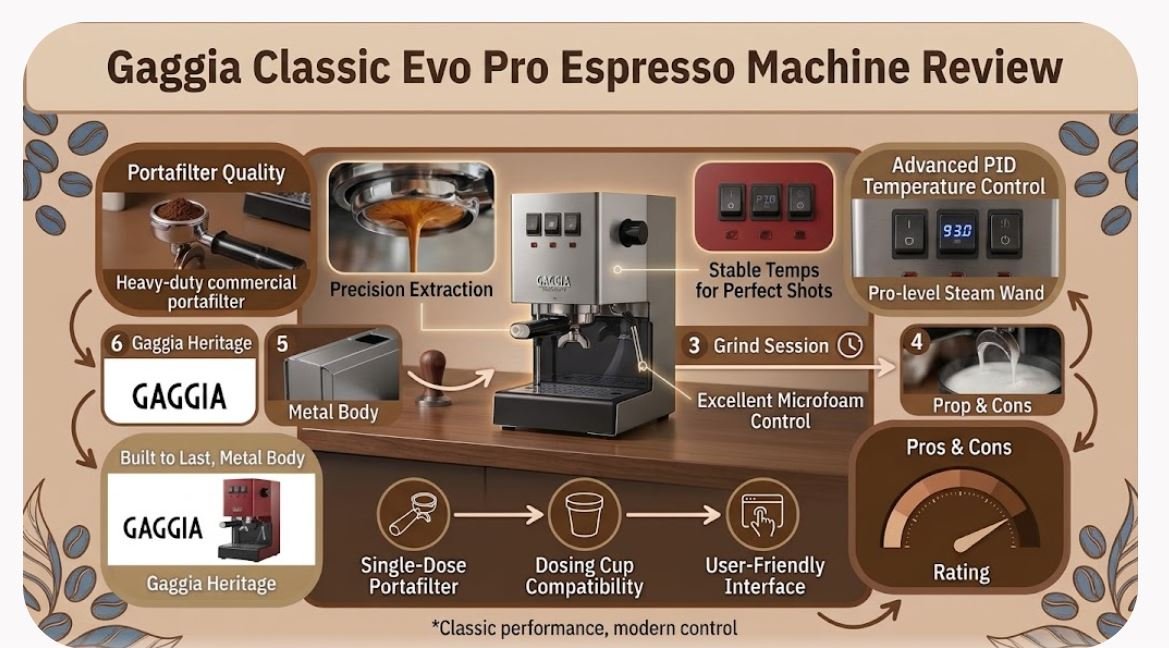
The Gaggia RI9380/51 Classic Evo Pro Espresso Machine brings traditional espresso-making equipment into a compact home setup. Finished in Industrial Grey, this model combines a stainless-steel exterior, a commercial-style 58mm portafilter, a professional steam wand, and a manual brewing system designed for people who want more control over their coffee.
Part of the well-known Gaggia Classic family, the Evo Pro received several hardware improvements in its 2023 revision, including an updated grouphead assembly, a stainless-steel dispersion plate, and an internally coated aluminium boiler.
However, this model deserves a closer look before purchasing. Some 2023 Evo Pro owners reported black particles appearing in water from the steam wand, raising questions about the boiler’s internal coating. Temperature management and the absence of factory PID control are also worth considering.
This research-based review examines the RI9380/51’s features, independent performance testing, documented boiler concerns, and owner feedback. It is not a hands-on test of the exact Industrial Grey unit. The goal is to help you understand what you are buying and whether this traditional espresso machine fits your coffee routine.
Quick Verdict: Is the Gaggia Classic Evo Pro Worth Buying?
The Gaggia Classic Evo Pro is worth considering if you enjoy manual espresso preparation and want a machine with traditional components, a 58mm portafilter, and a capable steam wand.
Its strongest advantages are its solid construction, repair-friendly design, and enthusiast-oriented brewing system.
However, the lack of factory PID control, single-boiler workflow, and documented history of coating-related complaints on some 2023 units make buying the correct revision particularly important.
It makes the most sense when the boiler condition, exact specification, and warranty are clearly confirmed.
What Is the Gaggia RI9380/51 Classic Evo Pro?
The Gaggia RI9380/51 is the Industrial Grey version of the Gaggia Classic platform, identified in Gaggia’s service documentation as the Grey 120V US configuration.
The Classic Evo Pro builds on the traditional Gaggia Classic design, retaining manual controls while introducing several internal improvements.
Unlike automatic espresso machines, it does not grind beans, measure coffee doses, or prepare milk automatically. Users control the entire process, from grinding and tamping to extraction and milk steaming.
The 2023 Evo Pro revision introduced several important changes:
- An internally coated aluminium boiler.
- A solid brass grouphead and mounting structure.
- A stainless-steel dispersion plate.
- An all-stainless-steel portafilter.
- An updated pressure-relief and mounting arrangement.
- A 9-bar OPV spring for US and Canadian versions.
These changes make the Evo Pro more appealing to traditional espresso enthusiasts, although they do not eliminate every limitation of the Classic platform.
Gaggia RI9380/51 Technical Specifications
The following specifications describe the North American 2023 Classic Evo Pro platform. Some electrical and accessory details should be confirmed against the exact unit and seller documentation.
| Specification | Details |
|---|---|
| Brand | Gaggia |
| Model | RI9380/51 |
| Finish | Industrial Grey |
| Machine type | Semi-automatic espresso machine |
| Boiler | Single internally coated aluminium boiler (2023 revision) |
| Grouphead | Brass |
| Dispersion plate | Stainless steel |
| Portafilter | 58mm stainless steel |
| Pump rating | 15 bar nominal |
| OPV | 9-bar spring on US/Canadian Evo Pro units |
| Temperature control | Thermostat-based |
| PID | No factory PID |
| Steam wand | Professional two-hole design |
| Water reservoir | 2.1 liters |
| Solenoid valve | Three-way |
| Controls | Three rocker switches |
| Electrical configuration | 120V US version |
| Grinder | Not included |
The 15-bar pump rating and 9-bar OPV setting describe different parts of the pressure system. The pump’s nominal rating should not be mistaken for the pressure applied to the coffee puck.
For the Industrial Grey RI9380/51, verify the electrical rating on the machine’s identification label before purchasing, particularly if ordering internationally.
Industrial Grey Design and Build Quality
The Industrial Grey finish gives the Gaggia Classic Evo Pro a more understated appearance than its brighter color options.
Its design follows the traditional Classic layout, with a metal exterior, front-facing rocker switches, a side-mounted steam control knob, and a removable drip tray.
The overall construction is one of the machine’s main attractions.
The 2023 revision also introduced improvements to several internal components. CoffeeGeek’s examination of a Polar White Evo Pro sample identified a solid brass grouphead, stainless-steel dispersion plate, and stainless-steel portafilter.
The machine also includes a passive cup-warming surface on top, using heat from the boiler and internal components.
However, the practical design is not without drawbacks. CoffeeGeek found the clearance beneath the portafilter relatively restrictive, particularly when using taller cups or a scale.
The water reservoir holds approximately 2.1 liters, which is generous for a machine of this size. However, its smoked plastic construction can make the water level difficult to see.
Overall, the Industrial Grey version offers a classic espresso-machine appearance rather than a modern touchscreen experience.
Understanding the Boiler: What Makes the 2023 Evo Pro Different?
The boiler is one of the most important components to understand before buying the Gaggia RI9380/51.
Unlike the later Gaggia Classic E24, which uses a lead-free brass boiler, the 2023 Evo Pro revision uses an internally coated aluminium boiler.
This distinction matters because the two machines belong to different hardware generations.
Gaggia’s 2023 Evo Pro revision introduced an internal industrial coating intended to provide protection against scale and corrosion. CoffeeGeek also documented this coating when examining the machine.
The grouphead, however, is made from solid brass. The stainless-steel dispersion plate is another separate component.
These details are sometimes confused in product descriptions. A brass grouphead does not mean the machine has a brass boiler.
What Was the Gaggia Classic Evo Pro Boiler Coating Issue?
Some owners of 2023 Gaggia Classic Evo Pro machines reported black flakes appearing in water dispensed through the steam wand.
The issue became widely discussed in the home espresso community because owners suspected that the boiler’s internal coating was deteriorating.
There is also a publicly available US Consumer Product Safety Commission incident report.
The report concerns a 2023 stainless-steel Gaggia Classic Evo Pro, model RI9380/46, rather than the exact Industrial Grey RI9380/51. The consumer described finding black flakes while using the steam wand.
Gaggia’s response stated that the product was certified according to applicable UL standards and complied with relevant food-contact requirements. The company also stated that no injury had been reported and that the case was resolved.
This distinction is important. The incident report does not establish that every Evo Pro has a defective boiler, that every RI9380/51 is affected, or that the reported particles represent a proven health hazard.
Nevertheless, the reports are relevant to buyers considering the same 2023 Evo Pro platform.
What Should You Check Before Buying?
Do not rely on the Industrial Grey finish or the Evo Pro name alone to identify the internal hardware.
Ask the seller to confirm:
- The exact model and serial number.
- Whether the machine still has its original coated aluminium boiler.
- Whether the boiler has been replaced.
- Whether replacement or service documentation is available.
- Whether the seller provides warranty support.
Some later machines and replacement configurations may have different boiler arrangements.
If an existing machine produces unexplained black particles, stop using it and contact Gaggia or the seller for inspection rather than assuming the particles are harmless.
Espresso Brewing Performance: What Can You Expect?
The Gaggia Classic Evo Pro is designed around traditional espresso preparation.
Its 58mm portafilter supports standard-sized espresso baskets, while its manual operation allows users to control coffee dose, grind size, distribution, tamping, and extraction.
This provides plenty of room to experiment with different coffee beans and brewing recipes.
However, the machine does not compensate for poor puck preparation or an unsuitable grinder.
For consistent results, an espresso-capable burr grinder is essential. Freshly ground coffee, an appropriate dose, even distribution, and repeatable tamping all contribute to better extraction.
The three-way solenoid valve is another useful feature. After brewing, it releases pressure from the portafilter, helping leave a drier coffee puck.
For home baristas who enjoy adjusting their espresso recipes, the Evo Pro offers a familiar and flexible platform.
Temperature Stability: Does the Evo Pro Have PID Control?
The Gaggia Classic Evo Pro does not include factory PID temperature control.
Instead, it uses a thermostat-based heating system. The heating element cycles on and off to maintain boiler temperature within its operating range.
The limitation is that the temperature at the grouphead can change during brewing.
CoffeeGeek’s Mark Prince evaluated a 2023 Evo Pro sample using a Scace temperature-measuring device.
During the test, the grouphead temperature started at approximately 94°C and declined to around 89°C by the 25th second of extraction.
The reviewer also found that paying attention to the machine’s heating indicator helped produce more predictable espresso.
One suggested approach was to flush the grouphead until the indicator light switched off, prepare the coffee puck, and begin extraction shortly after the heating indicator returned.
This is an example of temperature surfing, a technique used by Gaggia Classic owners to manage brewing temperature without a PID.
The findings come from CoffeeGeek’s test of a Polar White Evo Pro sample, not a direct test of the Industrial Grey RI9380/51.
The practical takeaway is that the machine can produce good espresso, but consistent results require a repeatable brewing routine.
Milk Frothing and Steam Wand Performance
The Gaggia Classic Evo Pro includes a professional stainless-steel steam wand with a two-hole tip.
Unlike automatic milk-frothing systems, it requires users to control the steam wand position and milk texture manually.
This gives home baristas the opportunity to develop proper microfoam for cappuccinos, flat whites, and lattes.
CoffeeGeek’s testing found that the machine took approximately 45 seconds to transition from brewing to steam-ready mode.
In its test, the reviewer also steamed approximately 180ml of milk to 65°C in around 40–45 seconds using the standard workflow.
These are reviewer-specific measurements rather than guaranteed results for every machine.
The steam wand can produce suitable milk texture, but technique matters. Users need to introduce a small amount of air near the milk surface before creating a whirlpool to finish the texture.
The machine is therefore better suited to people willing to learn manual milk steaming than those who want automatic results.
Single-Boiler Workflow and Everyday Convenience
The Evo Pro uses a single-boiler heating system.
This means the machine cannot brew espresso and steam milk simultaneously.
After pulling an espresso shot, users must activate steam mode and allow the boiler to reach a higher temperature before frothing milk.
After steaming, the boiler must be cooled and refilled appropriately before preparing another espresso.
For someone making one cappuccino or latte in the morning, this workflow is manageable.
However, preparing several milk-based drinks in succession can become time-consuming.
The 2.1-liter water reservoir provides good water capacity, but it does not change the limitations of the relatively small boiler.
If speed and convenience are your main priorities, a machine with a more advanced heating system may be a better fit.
Cleaning, Maintenance, and Long-Term Ownership
The Gaggia Classic Evo Pro has a relatively straightforward mechanical layout, which is one reason the Classic platform has developed a strong enthusiast community.
Regular maintenance includes:
- Cleaning the portafilter and filter baskets.
- Wiping and purging the steam wand after every use.
- Cleaning the grouphead and shower screen.
- Emptying and washing the drip tray.
- Backflushing with an appropriate blind basket and cleaning product.
- Descaling according to the manufacturer’s instructions and local water conditions.
The three-way solenoid valve supports backflushing, making grouphead maintenance more convenient.
The availability of replacement components is another advantage for people interested in keeping their espresso machines for several years.
However, electrical or pressure-system modifications can affect warranty coverage and introduce safety risks. PID installations and OPV changes should only be performed by qualified people using appropriate components.
For long-term ownership, a documented service history and access to genuine replacement parts are more valuable than simply choosing a particular exterior color.
Gaggia Classic Evo Pro Pros and Cons
Pros
- 58mm portafilter: Supports a widely used espresso basket format.
- Professional steam wand: Allows manual microfoam preparation and latte art.
- Brass grouphead: Provides substantial metal construction.
- Three-way solenoid valve: Helps release pressure after brewing.
- Compact design: Fits into many home coffee stations.
- Repair-friendly platform: Has a well-established enthusiast and replacement-parts ecosystem.
- Manual control: Makes it suitable for people interested in learning espresso techniques.
Cons
- No factory PID: Brewing temperature requires manual management.
- Single-boiler design: Cannot brew and steam simultaneously.
- Boiler coating history: Some 2023 units have documented flaking reports.
- Learning curve: Consistent results require attention to temperature and extraction.
- Separate grinder required: Adds to the total setup cost.
- Limited cup clearance: Taller cups and some scales may not fit comfortably.
Gaggia Classic Evo Pro RI9380/51 vs Gaggia Classic E24
The Gaggia Classic Evo Pro and Classic E24 share a traditional manual espresso-making approach, but their boiler configurations are different.
The 2023 Evo Pro uses an internally coated aluminium boiler, whereas the later E24 introduces a lead-free brass boiler and an upgraded group.
That makes the E24 the more relevant option for buyers specifically interested in the brass-boiler revision.
However, the E24 still retains a single-boiler design and does not provide factory PID temperature control.
The Industrial Grey Evo Pro is worth considering when its exact hardware revision, condition, and purchase price make sense.
For a detailed discussion of the later brass-boiler version, read our separate Gaggia Classic E24 Review.
Who Should Buy the Gaggia RI9380/51 Classic Evo Pro?
The Industrial Grey Classic Evo Pro is best suited to home espresso enthusiasts who enjoy controlling the brewing process.
It makes sense for people who already own an espresso-capable grinder, appreciate traditional 58mm accessories, and are comfortable learning temperature management.
It is less suitable for buyers who want automatic milk preparation, simultaneous brewing and steaming, or consistent temperature control without manual adjustments.
Buyers considering used or older stock should also verify the exact boiler revision and service history before making a decision.
Frequently Asked Questions
Is the Gaggia RI9380/51 Classic Evo Pro worth buying?
It can be worthwhile if you prefer traditional espresso preparation and find a unit with verified hardware, good condition, and suitable warranty support.
What color is the Gaggia RI9380/51?
The RI9380/51 is identified as the Industrial Grey version in Gaggia’s model documentation.
Does the Gaggia Classic Evo Pro have a brass boiler?
The 2023 Evo Pro revision discussed in this review uses an internally coated aluminium boiler. The later Classic E24 uses a lead-free brass boiler.
Does the Gaggia RI9380/51 have PID?
No. The standard Evo Pro uses thermostat-based temperature control without factory PID functionality.
Is the Gaggia Classic Evo Pro a single-boiler machine?
Yes. It uses one boiler for espresso brewing and steam production, so the two operations cannot happen simultaneously.
Does the Gaggia Classic Evo Pro include a grinder?
No. A separate espresso-capable coffee grinder is required.
What is the difference between the Gaggia Evo Pro and E24?
The main hardware distinction is the boiler configuration. The 2023 Evo Pro uses an internally coated aluminium boiler, while the E24 introduces a larger lead-free brass boiler.
Final Verdict: Is the Gaggia Classic Evo Pro Worth Buying?
The Gaggia RI9380/51 Classic Evo Pro remains an interesting option for people who appreciate traditional espresso equipment and manual brewing control.
Its 58mm portafilter, professional steam wand, brass grouphead, and repair-friendly construction are meaningful strengths.
However, the lack of PID control, single-boiler workflow, and documented coating concerns on some 2023 units deserve careful consideration.
The bottom line: Buy the Industrial Grey Classic Evo Pro for its traditional espresso platform, but verify its exact boiler revision, condition, and warranty before committing to the purchase.

- Breville BES878BSS Barista Pro Espresso Machine Review: Features, Performance, and Buying Guide - October 31, 2026
- Gaggia RI9380/51 Classic Evo Pro Espresso Machine Review: Features, Performance, and What to Know Before Buying - October 31, 2026
- Gaggia RI9380/46 E24 Espresso Machine Review: Is the Brass Boiler Upgrade Worth It? - October 31, 2026