
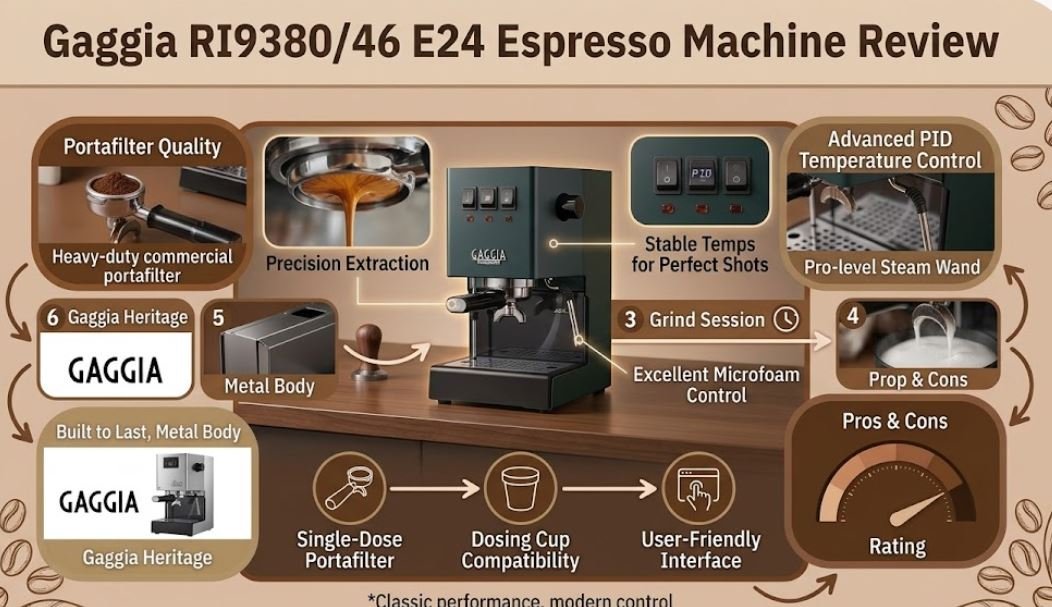
The Gaggia Classic has earned a loyal following among home espresso enthusiasts for its traditional design, manual controls, and repair-friendly construction. The Gaggia RI9380/46 E24 Espresso Machine continues that approach while introducing an important hardware upgrade: a lead-free brass boiler and an upgraded brass group.
Finished in brushed stainless steel, the E24 combines a traditional espresso-making experience with features designed to improve brewing and steaming performance. It includes a professional-style steam wand, a stainless-steel filter-holder, a three-way solenoid valve, and a 2.1-liter water reservoir.
However, a brass boiler does not automatically solve every problem associated with temperature consistency. Independent testing has identified noticeable temperature changes between consecutive shots, while some owners have discussed difficulties managing steam pressure.
So, is the Gaggia Classic E24 a worthwhile investment for home espresso enthusiasts? Let’s examine its specifications, independent test results, everyday workflow, and reported limitations before making that decision.
Quick Verdict: Is the Gaggia Classic E24 Worth Buying?
The Gaggia Classic E24 is a good option for people who enjoy traditional espresso preparation and want a machine with substantial metal components and manual controls.
Its lead-free brass boiler, 58mm filter-holder, and professional steam wand make it an appealing enthusiast machine. However, the absence of factory PID temperature control and its single-boiler design mean that users must learn how to manage brewing temperature and steaming.
It is best suited to buyers who enjoy developing barista skills rather than those looking for an effortless, automated coffee experience.
What Is the Gaggia RI9380/46 E24 Espresso Machine?
The Gaggia RI9380/46 E24 is part of the Gaggia Classic family of manual home espresso machines.
Its most important development is the introduction of an upgraded lead-free brass boiler alongside a brass group. Earlier Classic models were available with different boiler configurations, so buyers should pay attention to the exact E24 revision rather than assuming that every Gaggia Classic has the same internal construction.
The E24 retains the familiar manual operating approach. Users control espresso brewing through physical buttons and prepare milk manually with the steam wand.
The result is a machine that emphasizes direct control over automation. You choose the coffee, adjust the grinder, prepare the portafilter, and control the extraction yourself.
For people who enjoy understanding the details behind espresso preparation, that simplicity can be a genuine advantage.
Gaggia Classic E24 Technical Specifications
According to Gaggia’s official product information, the E24 includes the following features:
| Specification | Details |
|---|---|
| Model | RI9380/46 E24 |
| Finish | Brushed stainless steel |
| Machine type | Manual espresso machine |
| Boiler | Lead-free brass |
| Group | Lead-free brass |
| Portafilter | Stainless steel, 58mm |
| Pump rating | 15 bar nominal |
| Boiler configuration | Single boiler |
| Temperature control | Thermostat-based; no factory PID |
| Solenoid valve | Three-way |
| Steam wand | Professional stainless steel |
| Water reservoir | 2.1 liters |
| Interface | Three rocker buttons with indicator lights |
| Dimensions | 20 × 35.5 × 27 cm |
| Weight | 8.1 kg |
| US electrical specification | 120V, 60Hz, 1350W |
The machine also includes three filter baskets, including a pressurized option, and a plastic tamper.
One detail worth understanding is the 15-bar pump specification. This is the manufacturer’s nominal pump rating, not a statement that espresso is extracted at 15 bar. Kaffeemacher measured the tested machine operating at approximately 8–9 bar during brewing.
For the exact electrical configuration and included accessories, check the official specifications for the RI9380/46 US version before ordering.
Design and Build Quality: A Traditional Stainless-Steel Espresso Machine
The brushed stainless-steel exterior gives the Gaggia Classic E24 a straightforward, traditional appearance.
Rather than relying on a touchscreen or complicated digital interface, the machine uses three rocker buttons with indicator lights for its main functions.
Its construction includes several notable components:
- Brushed stainless-steel exterior.
- Lead-free brass boiler and group.
- Stainless-steel filter-holder.
- Professional stainless-steel steam wand.
- Stainless-steel cup-warming plate.
- Removable water reservoir and drip tray.
Gaggia also redesigned some exterior details to improve water-level visibility and drip-tray stability.
The machine weighs approximately 8.1 kg, making it relatively substantial for its compact countertop footprint.
There are a few practical compromises. The included tamper is plastic, and the machine does not offer a digital display, automatic shot timer, or programmable brewing interface.
That is not necessarily a problem for traditional espresso enthusiasts, but buyers expecting modern convenience features may find the design basic.
The Brass Boiler Upgrade: What Does It Actually Improve?
The brass boiler is the most important hardware change in the E24.
According to Gaggia, the upgraded lead-free brass boiler has a higher capacity than the previous configuration and can store more heat. The manufacturer says this helps improve temperature stability, steam-pressure control, and the duration of steam production.
These are meaningful improvements on paper.
A boiler’s material and thermal mass influence how it responds to heating and water movement. However, boiler material alone cannot guarantee consistent brewing temperature.
That distinction becomes especially important when examining independent measurements.
What Independent Temperature Testing Revealed
Kaffeemacher tested the Gaggia Classic E24 using a Scace 2 measurement device positioned directly in the portafilter.
In its standard test, the team allowed the machine to heat for 15 minutes and 40 seconds, then prepared five double espressos at one-minute intervals.
The measured average temperatures were:
| Shot | Measured temperature |
|---|---|
| 1 | 95.8°C |
| 2 | 91.7°C |
| 3 | 90.6°C |
| 4 | 89.7°C |
| 5 | 88.2°C |
The difference between the first and fifth shots was 7.6°C.
This revealed a significant limitation: the first shot was substantially hotter, while subsequent shots became progressively cooler under the testing conditions.
The team then tested an improved flushing and waiting routine.
Their adjustments were:
- Flush the group head for 7–8 seconds before the first shot.
- Wait approximately 1.5–2 minutes between consecutive shots.
With this routine, the measured temperatures became:
| Shot | Standard routine | Improved routine |
|---|---|---|
| 1 | 95.8°C | 91.5°C |
| 2 | 91.7°C | 92.3°C |
| 3 | 90.6°C | 90.1°C |
| 4 | 89.7°C | 90.5°C |
| 5 | 88.2°C | 91.6°C |
The improvement is clear, although the temperatures are not perfectly identical.
Kaffeemacher’s testing demonstrates an important point: the brass boiler provides a stronger hardware foundation, but the machine still depends on proper temperature management.
Does the Gaggia Classic E24 Have PID Temperature Control?
No. The standard E24 does not include factory PID temperature control.
It uses a thermostat-based heating system, meaning users cannot simply select a specific brewing temperature through a digital interface.
This is one of its biggest limitations compared with more temperature-controlled espresso machines.
Some enthusiasts use a technique called temperature surfing, which involves carefully managing heating and flushing behavior to obtain more predictable brewing conditions.
PID upgrade kits are also available from third-party developers, but these are modifications rather than standard factory features.
For buyers who want precise temperature selection without learning additional techniques, a machine with built-in PID control may be a more convenient choice.
Espresso Brewing Performance
The Gaggia Classic E24 offers a traditional manual espresso workflow.
Users control the coffee dose, grind size, puck preparation, and brewing duration. The machine does not automatically determine the finished beverage volume, so a digital scale is useful for repeatable results.
Gaggia includes a stainless-steel filter-holder with a nominal 58mm format and three filter options.
The three-way solenoid valve is another useful feature. According to Gaggia, it helps manage pressure inside the filter-holder and releases pressure after brewing, leaving a drier coffee puck that is easier to remove.
Understanding the 58mm Portafilter
The 58mm format is familiar to espresso enthusiasts because it is widely used in traditional espresso equipment.
However, there is an important compatibility detail.
Kaffeemacher reported that the E24 portafilter’s bayonet geometry differs from a standard 58mm portafilter. Its testing found that some standard aftermarket 58mm portafilters do not fit the machine, even though compatible baskets can be used.
Therefore, do not assume that every 58mm bottomless portafilter or accessory will fit simply because the product specification says 58mm.
Check compatibility with the exact E24 model before purchasing additional accessories.
Milk Steaming and Cappuccino Preparation
The E24 includes a professional stainless-steel steam wand for manually texturing milk.
It can prepare milk for cappuccinos and lattes, but the single-boiler architecture affects the workflow.
After brewing espresso, the boiler must heat up to steam temperature before milk preparation. After steaming, it must return to suitable brewing conditions before the next espresso.
In its independent test, Kaffeemacher reported that the transition to steam temperature took approximately 60 seconds. Its reviewer also observed that steam power was strongest initially and declined after approximately 15–20 seconds.
The resulting milk texture was described as creamy and pleasant, but achieving it required practice and careful pitcher positioning.
Purging the wand before steaming is also important because condensation water can come out first.
For someone preparing one cappuccino at a time, this may be manageable. However, people who regularly make several milk-based drinks consecutively may prefer a machine with stronger steam endurance and a more convenient heating system.
What Owners Report About Steam Performance
Independent laboratory testing provides useful measurements, but owner feedback reveals how a machine behaves in everyday kitchens.
Several discussions in the Gaggia Classic community describe difficulties with steam pressure and timing.
In one E24 discussion, an owner reported receiving only a few seconds of strong steam before pressure dropped noticeably.
Other participants suggested adjusting the timing of the steam cycle and purging condensation before introducing the milk.
A separate discussion described an E24 owner experiencing similar pressure behavior, with another participant explaining that beginning steaming before the indicator light activates helped maintain better performance.
These are individual owner experiences, not proof that every E24 has a defective steam system.
Another owner discussion concerns water dripping from the steam wand while the machine is switched on. Some community members describe occasional dripping as familiar behavior, while others find it inconvenient.
The important distinction is between normal residual water or pressure-related behavior and persistent leakage caused by a faulty valve.
If dripping is excessive or continues unexpectedly, the machine should be inspected rather than assuming that every leak is normal.
For potential buyers, the takeaway is straightforward: the E24 can produce useful steam, but its manual timing requirements and single-boiler limitations should be part of the buying decision.
Everyday Workflow: What Is It Like to Use?
The E24 is designed around a simple sequence rather than automated drink preparation.
A typical workflow involves:
- Allowing the machine and portafilter to warm up.
- Grinding and weighing the coffee.
- Distributing and tamping the grounds.
- Preparing the machine for extraction.
- Brewing espresso while monitoring the output.
- Switching to steam mode when preparing milk.
- Purging and cleaning the steam wand afterward.
Kaffeemacher measured a warm-up requirement of approximately 15 minutes for its testing procedure.
Its recommended routine also included a 7–8-second initial flush and a 1.5–2-minute interval between shots.
These are findings from its particular test procedure, not universal timing guarantees for every machine and operating environment.
The machine is straightforward to operate, but producing repeatable espresso requires attention.
This is where the E24 differs from more automated home coffee machines: it gives users more responsibility for the final result.
Cleaning and Maintenance
Regular cleaning helps preserve espresso quality and machine performance.
The E24 requires manual maintenance rather than relying on an automatic cleaning program.
Useful maintenance tasks include:
- Cleaning the portafilter and filter baskets after brewing.
- Wiping and purging the steam wand after milk preparation.
- Emptying and cleaning the drip tray.
- Cleaning the group head.
- Backflushing with an appropriate blind basket and manufacturer-approved cleaning procedure.
- Descaling according to water conditions and Gaggia’s instructions.
Pay particular attention to water quality. Excessive mineral buildup can affect internal components and heating performance.
Gaggia provides official operating instructions for the US E24 version. Following those instructions is preferable to using generic maintenance routines intended for different machines.
Gaggia Classic E24 Pros and Cons
Pros
- Lead-free brass boiler: A meaningful hardware upgrade over earlier aluminium-boiler configurations.
- Brass group: Adds to the machine’s traditional metal construction.
- 58mm filter-holder: Provides access to a familiar espresso basket format, subject to model-specific accessory compatibility.
- Professional steam wand: Allows manual milk texturing for cappuccinos and lattes.
- Three-way solenoid valve: Helps release pressure after extraction.
- Compact construction: Fits comfortably into many home coffee stations.
- Manual operation: Appeals to users who want to develop espresso-making skills.
Cons
- No factory PID: Brewing temperature cannot be selected digitally.
- Single-boiler design: Espresso brewing and milk steaming cannot happen simultaneously.
- Temperature management: Consecutive shots may require careful flushing and waiting.
- Learning curve: Consistent results depend on technique.
- Manual workflow: No automatic grinder, shot timer, or programmable volume control.
- Steam limitations: Independent testing identified declining steam output during longer steaming sessions.
- Accessory compatibility: Not every standard 58mm portafilter fits the E24.
Who Should Buy the Gaggia Classic E24?
The Gaggia Classic E24 makes the most sense for people who enjoy learning how espresso machines work.
It is particularly suitable for:
- Home baristas who prefer manual espresso preparation.
- Coffee enthusiasts interested in grind size, extraction, and temperature control.
- Buyers who appreciate brass components and stainless-steel construction.
- People who usually prepare one or two espresso drinks at a time.
- Users who may want to explore compatible accessories and modifications.
It may be less suitable for people who want automatic milk preparation, highly consistent consecutive shots without manual intervention, or the convenience of a dual-boiler machine.
If your priority is convenience rather than learning the brewing process, consider a more automated espresso machine.
Frequently Asked Questions
Is the Gaggia Classic E24 worth buying?
It can be a worthwhile purchase for home espresso enthusiasts who appreciate manual controls and are willing to manage brewing temperature. Its brass boiler and traditional construction are attractive, but the absence of factory PID control is an important limitation.
Does the Gaggia RI9380/46 E24 have a brass boiler?
Yes. Gaggia identifies the E24 as having an upgraded lead-free brass boiler and brass group.
Does the Gaggia Classic E24 have PID?
No. The standard E24 does not include factory PID temperature control. Third-party modifications are available, but they are not standard features.
Is the Gaggia Classic E24 a single-boiler machine?
Yes. Its single-boiler configuration means it must transition between espresso brewing and steam production.
Can the Gaggia E24 make cappuccino and latte?
Yes. It has a manual stainless-steel steam wand that can texture milk for cappuccinos and lattes. However, it requires practice and appropriate timing.
Does the Gaggia Classic E24 include a coffee grinder?
No. You need a separate grinder capable of producing espresso-fine coffee grounds.
Is every 58mm portafilter compatible with the Gaggia E24?
No. Although Gaggia specifies a 58mm filter-holder, independent testing has identified differences in its bayonet geometry. Check the exact accessory compatibility before buying an aftermarket portafilter.
Final Verdict: Is the Gaggia Classic E24 Worth It?
The Gaggia RI9380/46 E24 Espresso Machine is a traditional home espresso machine with meaningful hardware improvements, especially its lead-free brass boiler and upgraded group.
Its strengths are real, but so are its compromises. Independent temperature measurements show that the machine benefits considerably from careful flushing and waiting routines, while steam preparation requires practice.
For someone who wants to understand espresso rather than simply press a button, the E24 offers an engaging starting point.
For someone who values effortless operation and consistent performance across several consecutive drinks, a more automated or temperature-controlled machine may be a better investment.
The bottom line: The Gaggia Classic E24 is best for people who want to learn, control, and improve their espresso-making skills—not for buyers expecting professional-level convenience straight out of the box.

- Breville BES878BSS Barista Pro Espresso Machine Review: Features, Performance, and Buying Guide - October 31, 2026
- Gaggia RI9380/51 Classic Evo Pro Espresso Machine Review: Features, Performance, and What to Know Before Buying - October 31, 2026
- Gaggia RI9380/46 E24 Espresso Machine Review: Is the Brass Boiler Upgrade Worth It? - October 31, 2026