
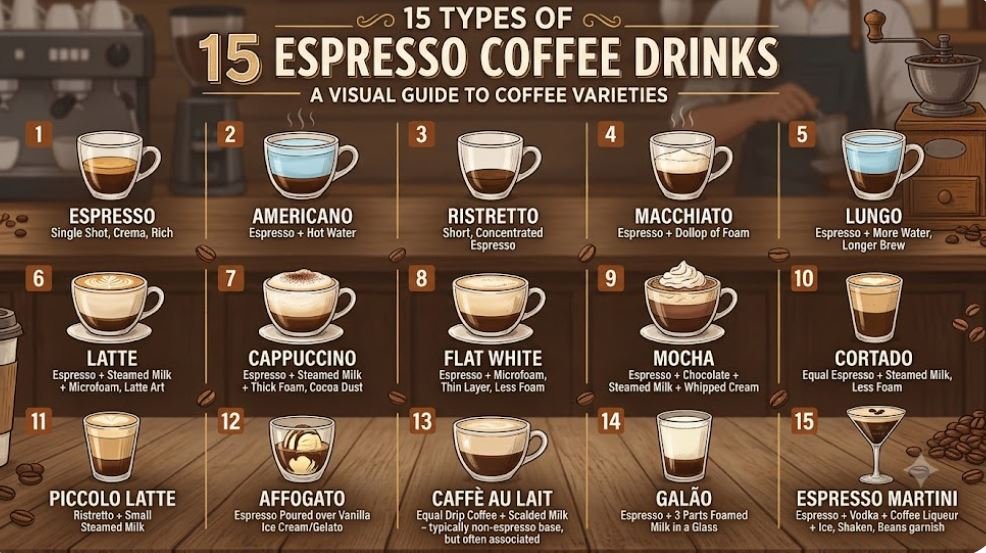
Espresso drinks come in many different styles, from a small and intense espresso to creamy lattes, foamy cappuccinos, balanced cortados, refreshing Americanos, and dessert-style affogatos. Although many of these beverages begin with the same concentrated espresso shot, differences in milk, water, foam, serving size, and additional ingredients create very different coffee experiences.
The most popular types of espresso drinks include espresso, doppio, ristretto, lungo, Americano, macchiato, cortado, cappuccino, latte, flat white, mocha, breve, red eye, black eye, and affogato. Other regional and specialty drinks add even more variety.
Understanding the different types of espresso coffee drinks can help you choose the right beverage based on your preferred coffee strength, milk texture, sweetness, caffeine level, and serving size. It can also make it easier to prepare café-style espresso drinks at home.
This guide explains 20 types of espresso drinks, their ingredients, preparation methods, flavour characteristics, typical ratios, and key differences. It also compares popular drinks such as lattes, cappuccinos, flat whites, cortados, and macchiatos and explains which espresso drinks are best for beginners, milk lovers, strong-coffee drinkers, and home baristas.
What Is an Espresso Coffee Drink?
An espresso coffee drink is a beverage that uses espresso as its main coffee base. Espresso is a concentrated coffee brewed by forcing hot water through finely ground coffee under pressure.
Depending on the drink, espresso may be combined with:
- Hot water
- Steamed milk
- Microfoam
- Milk foam
- Chocolate
- Half-and-half
- Ice cream or gelato
- Brewed coffee
- Other flavouring ingredients
The proportions of these ingredients are what make one espresso beverage different from another.
For example, a macchiato contains only a small amount of milk or foam, while a latte contains considerably more steamed milk. A cappuccino has a greater emphasis on foam, while a cortado balances espresso and steamed milk.
How Is Espresso Made?
Espresso is prepared by passing hot water through finely ground coffee under pressure. A common modern espresso recipe uses a coffee dose of around 18 grams and produces approximately 36 grams of espresso, although recipes vary according to the coffee, equipment, and desired style.
A typical espresso extraction may take roughly 25–30 seconds, but extraction time should not be treated as a universal rule. Grind size, dose, water temperature, pressure, coffee freshness, and the desired recipe all affect the final result.
A well-prepared espresso can have a concentrated body, noticeable sweetness, balanced acidity, and complex aromas. Depending on the coffee beans, flavours may include chocolate, caramel, nuts, fruit, spices, or floral notes.
The Main Components of an Espresso Shot
Espresso is often described in terms of three visual layers:
Crema
Crema is the lighter-coloured layer that can form on the surface of freshly extracted espresso. It contains emulsified coffee oils and gases released during extraction.
Crema can contribute to aroma and mouthfeel, but the amount of crema alone does not determine whether an espresso is high quality.
Body
The body refers to the fuller middle portion of the espresso experience. It contributes to the drink’s mouthfeel and overall richness.
Lower Extraction Portion
The darker liquid underneath the crema contains many of the dissolved compounds that contribute to espresso’s flavour and aroma.
The appearance of these layers changes during and after extraction, so espresso should be evaluated by its overall flavour and balance rather than appearance alone.
20 Types of Espresso Drinks
1. Espresso

Espresso is the foundation of many espresso-based drinks. It is a concentrated serving of coffee extracted under pressure and served without added milk or water.
A traditional single espresso is commonly served in a small cup. Modern specialty coffee recipes can vary considerably in dose and yield.
What Does Espresso Taste Like?
Espresso can taste intense, sweet, acidic, bitter, fruity, nutty, chocolatey, or floral depending on the beans and preparation. Because there is no milk or water added after extraction, the characteristics of the coffee are particularly noticeable.
Who Is Espresso Best For?
Espresso is ideal for people who enjoy concentrated coffee and want to taste the characteristics of the beans without milk or other ingredients.
2. Doppio
A doppio is a double espresso. Instead of a single serving of espresso, it contains two espresso shots or an equivalent double-shot preparation.
The larger coffee dose and yield provide more coffee and generally more caffeine than a single espresso.
What Does a Doppio Taste Like?
A doppio can provide a fuller and more intense coffee experience while maintaining the characteristics of the espresso recipe.
What Is a Doppio Used For?
Doppio is commonly enjoyed on its own and is also frequently used as the coffee base for drinks such as lattes and cappuccinos.
3. Ristretto
A ristretto is a shorter espresso extraction. It is generally prepared using a similar coffee dose to espresso but with a smaller beverage yield.
Because less water passes through the coffee, ristretto produces a smaller, concentrated drink.
How Does Ristretto Taste?
Ristretto is often associated with a concentrated body and prominent sweetness, although the actual flavour depends on the coffee and recipe.
It should not simply be described as “stronger espresso.” Its flavour profile can differ because changing the extraction yield changes which compounds are extracted and in what proportions.
Ristretto vs Espresso
The main difference is the amount of liquid produced during extraction.
Ristretto: shorter yield and smaller beverage.
Espresso: larger yield under the chosen espresso recipe.
4. Lungo
A lungo means “long” in Italian. It is an espresso-style preparation in which more water passes through the coffee compared with a conventional espresso recipe.
A lungo therefore produces a larger beverage than a traditional espresso.
What Does Lungo Taste Like?
Because the extraction is extended, a lungo can have a lighter body than a concentrated espresso while developing more pronounced bitter or roasted notes depending on the coffee and recipe.
Lungo vs Espresso
The key difference is the extraction yield.
An espresso is smaller and more concentrated, while a lungo is longer and produces more liquid.
Who Should Choose Lungo?
Lungo is a good option for people who want a longer black coffee while retaining an espresso-based preparation.
5. Americano
An Americano combines espresso with hot water. It provides a larger beverage while retaining the flavour characteristics of espresso.
A typical preparation begins with one or more espresso shots, followed by hot water. The exact ratio depends on personal preference and café style.
Americano vs Brewed Coffee
An Americano and brewed coffee may have similar appearances, but they are prepared differently.
An Americano begins with espresso and is then diluted with hot water. Brewed coffee is extracted directly using a brewing method such as drip brewing, pour-over, or batch brewing.
Can You Make an Iced Americano?
Yes. Espresso can be combined with cold water and ice to make an iced Americano.
This makes the Americano one of the easiest espresso drinks to prepare at home.
6. Macchiato
A traditional espresso macchiato is an espresso marked with a small amount of steamed milk or milk foam.
The Italian word macchiato means “marked” or “stained,” referring to the small amount of milk added to the espresso.
What Does a Macchiato Taste Like?
A macchiato remains strongly espresso-forward. The small amount of milk or foam softens the intensity without turning it into a predominantly milk-based beverage.
Traditional Macchiato vs Modern Versions
It is important to distinguish a traditional espresso macchiato from modern café drinks that may use significantly more milk, caramel, syrups, or other ingredients.
If you want a classic, small and strong espresso drink, the traditional macchiato is a better reference point.
7. Cortado

A cortado is an espresso drink made with espresso and a relatively similar amount of steamed milk. It is traditionally associated with Spanish coffee culture.
The milk helps reduce some of espresso’s intensity while allowing the coffee flavour to remain prominent.
Cortado Texture
A cortado generally contains little foam compared with a cappuccino. The steamed milk should provide a smooth, integrated texture.
Cortado vs Macchiato
A macchiato contains a small amount of milk or foam and remains strongly espresso-focused.
A cortado contains considerably more milk and provides a more balanced relationship between coffee and milk.
Who Should Choose Cortado?
Cortado is a good choice for people who want a balanced coffee flavour without the larger milk volume of a latte.
8. Cappuccino
A cappuccino combines espresso, steamed milk, and milk foam. It is one of the most recognised espresso-based coffee drinks.
Traditional proportions vary, but the drink generally has a stronger emphasis on foam than a latte.
What Does a Cappuccino Taste Like?
Cappuccino offers a noticeable espresso flavour balanced by the sweetness and creaminess of steamed milk.
Its foam creates a lighter, airier mouthfeel than a latte.
Cappuccino vs Latte
A latte generally contains more liquid steamed milk and a thinner foam layer.
A cappuccino typically contains less liquid milk and a more substantial foam component.
Therefore:
Latte = creamier and milkier
Cappuccino = foamier and more espresso-forward
9. Latte
A caffè latte, usually shortened to latte, combines espresso with a generous amount of steamed milk and a relatively thin layer of microfoam.
Because it contains more milk than many other traditional espresso drinks, it has a smooth and approachable flavour.
What Does a Latte Taste Like?
The milk softens the intensity of espresso and can emphasise sweet flavours such as caramel, chocolate, nuts, and mild fruit.
Latte Art
The silky microfoam used in a latte can be used to create latte art, including hearts, tulips, and rosettas.
Who Should Choose a Latte?
Latte is a good choice for people who:
- Prefer creamy coffee
- Find straight espresso too intense
- Enjoy milk-based beverages
- Like a smooth texture
- Want to experiment with latte art
10. Flat White
A flat white combines espresso with steamed milk and fine microfoam. It is generally smaller and more coffee-forward than a typical latte, although recipes and serving styles vary between cafés and countries.
Flat White vs Latte
The distinction is primarily related to serving size, milk quantity, and texture rather than a single universal recipe.
A flat white generally has:
- Less milk than a large latte
- A stronger coffee presence
- Fine, silky microfoam
- A smooth texture
A latte generally provides more milk and a milder coffee flavour.
Flat White vs Cappuccino
A cappuccino is more foam-focused, while a flat white typically emphasises smooth microfoam and an integrated espresso-and-milk texture.
11. Mocha
A mocha combines espresso, chocolate, and steamed milk. Depending on the recipe, chocolate may come from cocoa powder, chocolate sauce, or melted chocolate.
What Does Mocha Taste Like?
Mocha combines the bitterness and complexity of coffee with the sweetness and richness of chocolate.
Popular Mocha Variations
Common variations include:
- Dark chocolate mocha
- White chocolate mocha
- Peppermint mocha
- Caramel mocha
- Iced mocha
Who Should Choose Mocha?
Mocha is particularly suitable for people who enjoy sweet coffee and chocolate flavours.
12. Breve
A breve is similar to a latte but uses steamed half-and-half instead of regular milk.
Because half-and-half contains more fat than ordinary milk, the resulting beverage is particularly rich and creamy.
What Does a Breve Taste Like?
Breve has a fuller, buttery mouthfeel and can taste naturally rich and sweet.
Breve vs Latte
The main difference is the dairy ingredient.
Latte: espresso + steamed milk
Breve: espresso + steamed half-and-half
Because of its richer dairy content, a breve is generally more indulgent than a standard latte.
13. Red Eye
A Red Eye combines brewed coffee with one shot of espresso.
It is different from most traditional milk-based espresso drinks because its main liquid component is brewed coffee.
Why Is It Called Red Eye?
The name refers to the addition of espresso to regular brewed coffee. Regional terminology can vary, so names such as Red Eye, Black Eye, and Dead Eye are not always used consistently by every café.
Caffeine
Because it contains both brewed coffee and espresso, a Red Eye can contain considerably more caffeine than a typical single espresso. The exact amount depends on the serving size, coffee beans, and number of espresso shots.
14. Black Eye
A Black Eye is commonly described as brewed coffee with two espresso shots.
It is therefore stronger in caffeine and coffee flavour than a Red Eye when the same brewed-coffee serving is used.
Black Eye vs Red Eye
The simplest distinction is:
Red Eye: brewed coffee + one espresso shot
Black Eye: brewed coffee + two espresso shots
Terminology can vary between cafés, so it is always worth confirming the recipe when ordering.
15. Affogato
An affogato combines hot espresso with cold ice cream or gelato. It is often served as a dessert rather than as a conventional coffee beverage.
How Is Affogato Made?
A basic affogato can be prepared by:
- Adding a scoop of vanilla ice cream or gelato to a serving glass or cup.
- Brewing a fresh espresso.
- Pouring the hot espresso over the ice cream.
- Serving immediately.
Affogato Flavour
The hot espresso partially melts the cold gelato, creating a combination of concentrated coffee, creamy dairy, sweetness, and temperature contrast.
Popular pairings include:
- Vanilla gelato
- Chocolate gelato
- Hazelnut gelato
- Caramel ice cream
16. Café Con Panna
Café con panna is espresso topped with whipped cream.
The name refers to coffee served with cream, and the drink provides a simple contrast between intense espresso and rich whipped cream.
What Does Café Con Panna Taste Like?
The espresso provides bitterness, acidity, and roasted or fruity notes, while the whipped cream adds sweetness and richness.
It is a good choice for people who enjoy a small espresso-based drink with a dessert-like finish.
17. Espresso Con Panna
Espresso con panna is closely related to café con panna and is typically a shot of espresso topped with whipped cream.
The small serving size keeps the espresso flavour prominent while the cream adds sweetness and a softer texture.
It can be enjoyed as a simple dessert coffee or as an alternative to milk-based espresso drinks.
18. Marocchino
A marocchino is a small espresso-based drink associated with Italian café culture. It commonly combines espresso with cocoa or chocolate and milk foam.
The exact preparation can vary by café.
Marocchino Flavour
The combination of espresso, chocolate, and milk foam produces a richer and sweeter profile than plain espresso.
It is particularly appealing to people who enjoy mocha-style drinks but want a smaller serving.
19. Gibraltar
A Gibraltar is a small espresso-and-milk drink traditionally served in a Gibraltar glass. It is closely related in style to drinks such as the cortado.
The drink generally combines espresso with steamed milk and a small amount of microfoam.
Gibraltar vs Cortado
The two drinks are very similar, and terminology can vary depending on the café and region. One of the main distinctions traditionally associated with Gibraltar is the specific glass and café preparation style.
20. Piccolo Latte
A piccolo latte is a small milk-based espresso drink that combines espresso with steamed milk and a small amount of microfoam.
It provides a more concentrated coffee flavour than a larger latte because the serving contains less milk.
Who Should Try a Piccolo Latte?
Piccolo latte is useful for people who enjoy the smoothness of milk but want a stronger coffee presence and smaller serving size than a conventional latte.
Espresso Drinks Comparison: What’s the Difference?
Understanding the differences between espresso beverages becomes easier when comparing their coffee, milk, foam, and preparation.
| Drink | Main ingredients | Milk level | Foam | General character |
|---|---|---|---|---|
| Espresso | Espresso | None | None | Concentrated |
| Doppio | Double espresso | None | None | Larger, intense |
| Ristretto | Short espresso | None | None | Concentrated, short |
| Lungo | Long espresso | None | None | Longer black coffee |
| Americano | Espresso + water | None | None | Diluted and larger |
| Macchiato | Espresso + small milk/foam | Very low | Small | Espresso-forward |
| Cortado | Espresso + steamed milk | Moderate | Low | Balanced |
| Cappuccino | Espresso + milk + foam | Moderate | Higher | Foamy |
| Latte | Espresso + steamed milk | High | Low | Creamy |
| Flat White | Espresso + steamed milk | Moderate | Fine microfoam | Silky, coffee-forward |
| Mocha | Espresso + chocolate + milk | High | Low | Sweet and chocolatey |
| Breve | Espresso + half-and-half | High | Low | Rich and creamy |
| Red Eye | Brewed coffee + espresso | None | None | High coffee intensity |
| Black Eye | Brewed coffee + two espresso shots | None | None | Very high coffee intensity |
| Affogato | Espresso + ice cream | Dessert ingredient | None | Sweet and creamy |
Latte vs Cappuccino: What’s the Difference?
Both drinks combine espresso and milk, but the milk texture and proportions differ.
A latte generally contains more steamed milk and a thinner layer of foam. It therefore tastes creamier and less intense.
A cappuccino generally has a greater proportion of foam and a more pronounced espresso character.
Choose a latte if you prefer:
- More milk
- Creamier texture
- Mild coffee flavour
- Latte art
Choose a cappuccino if you prefer:
- More foam
- A stronger coffee presence
- A lighter, airy texture
- A traditional espresso-and-milk balance
Latte vs Flat White
Latte and flat white are often confused because both combine espresso with steamed milk.
The main practical differences are usually serving size, milk quantity, and foam texture.
A flat white generally uses less milk and has fine microfoam, giving it a stronger coffee presence.
A latte generally contains more steamed milk and offers a softer, creamier experience.
Cappuccino vs Flat White
A cappuccino is typically more foam-focused, while a flat white usually has a smooth layer of fine microfoam.
If you enjoy airy foam, cappuccino may be the better choice.
If you prefer silky milk and a stronger espresso presence, a flat white may suit you better.
Cortado vs Macchiato
The main difference is the amount of milk.
A traditional macchiato contains only a small amount of milk or foam, keeping espresso as the dominant component.
A cortado uses more steamed milk, producing a more balanced coffee-and-milk flavour.
Espresso vs Ristretto
Both are concentrated espresso-style beverages.
A ristretto generally has a smaller yield than a conventional espresso recipe. This can produce a different balance of sweetness, acidity, bitterness, and body.
If you want a shorter, concentrated extraction, try ristretto.
If you want a more conventional espresso recipe, choose espresso.
Espresso vs Lungo
Espresso and lungo differ primarily in extraction yield.
A lungo allows more water to pass through the coffee and therefore produces a larger beverage.
Espresso is smaller and generally more concentrated in mouthfeel.
Lungo may develop more bitter or roasted characteristics depending on the coffee and recipe.
Americano vs Drip Coffee
Although an Americano and drip coffee can look similar, they are made differently.
Americano: espresso + hot water.
Drip coffee: water is passed through coffee grounds using gravity and a filter.
An Americano can therefore provide the aromatic characteristics of espresso in a larger serving.
Which Espresso Drink Has the Most Milk?
Among the traditional drinks discussed here, a latte generally has a high proportion of milk. A breve is also very milk-rich but uses half-and-half rather than ordinary milk.
For a creamy, mild coffee experience, a latte is a common choice.
For something even richer, a breve may be preferable.
Which Espresso Drink Is the Strongest?
There are two different meanings of “strong.”
Flavour strength refers to how concentrated or intense the coffee tastes.
Caffeine strength refers to how much caffeine the drink contains.
These are not the same thing.
A ristretto can have a highly concentrated flavour, but that does not automatically mean it contains the most caffeine.
Drinks such as a Black Eye can contain considerably more caffeine because they combine brewed coffee with multiple espresso shots.
Espresso Drink Caffeine Comparison
Caffeine content varies according to the coffee beans, dose, serving size, extraction recipe, and number of espresso shots. Therefore, no single caffeine number applies to every café or preparation.
As a general guide:
| Drink | Relative caffeine |
|---|---|
| Single espresso | Moderate |
| Doppio | Higher than single espresso |
| Latte | Depends mainly on number of shots |
| Cappuccino | Depends mainly on number of shots |
| Americano | Depends mainly on number of shots |
| Red Eye | Higher because it combines brewed coffee and espresso |
| Black Eye | Higher because it combines brewed coffee and two espresso shots |
If caffeine intake is important to you, check the café’s serving size and recipe rather than relying only on the drink name.
Types of Espresso Drinks by Milk Content
One easy way to understand espresso beverages is to group them by how much milk they contain.
Little or No Milk
Examples include:
- Espresso
- Doppio
- Ristretto
- Lungo
- Americano
These drinks allow the coffee flavour to remain dominant.
Small Amount of Milk
Examples include:
- Macchiato
- Espresso con panna is different because it uses cream rather than milk.
Macchiato is particularly espresso-forward.
Moderate Milk
Examples include:
- Cortado
- Cappuccino
- Flat white
- Piccolo latte
These drinks balance coffee with milk.
Higher Milk Content
Examples include:
- Latte
- Breve
- Mocha
These drinks are generally smoother and creamier.
Which Espresso Drink Is Best for Beginners?
If you are new to espresso, the best drink depends on how you normally enjoy coffee.
Best beginner choice: Latte
A latte contains enough milk to soften the intensity of espresso and is generally approachable for people who are not accustomed to concentrated coffee.
Best for a stronger beginner option: Cappuccino
A cappuccino offers more noticeable espresso flavour while still providing milk and foam.
Best for coffee lovers: Cortado
A cortado provides a balanced relationship between espresso and milk.
Best for black-coffee drinkers: Americano
An Americano gives you a larger drink without adding milk.
Best Espresso Drinks to Make at Home
You do not need to start with complicated recipes. Several espresso drinks are relatively straightforward once you have a consistent espresso setup.
Easiest Espresso Drinks at Home
Espresso
Prepare the espresso and serve it directly.
Americano
Add hot water to espresso.
Latte
Prepare espresso and add steamed milk.
Cappuccino
Prepare espresso and add steamed milk with a thicker foam layer.
Mocha
Prepare espresso, add chocolate, and combine with steamed milk.
Equipment for a Home Espresso Setup
A basic home setup may include:
- Espresso machine
- Burr coffee grinder
- Digital coffee scale
- Tamper
- Milk pitcher
- Fresh coffee beans
- Suitable espresso cups
A grinder is particularly important because grind size has a major influence on espresso extraction.
How to Make Espresso Drinks for Two
Many espresso drinks can easily be prepared for two people.
For two servings:
- Grind enough fresh coffee for the required number of espresso shots.
- Prepare the espresso according to your machine’s recipe.
- Divide the espresso between two cups or prepare separate shots.
- Steam the required amount of milk for milk-based drinks.
- Pour the milk evenly into both drinks.
- Serve immediately.
For two people, lattes, cappuccinos, Americanos, cortados, and espressos are all easy options.
Best Espresso Drinks for Winter
Cold weather often makes richer and warmer drinks particularly appealing.
Good winter choices include:
Cappuccino
The combination of hot espresso, steamed milk, and foam makes cappuccino a classic warm beverage.
Mocha
Chocolate adds sweetness and richness to espresso and milk.
Breve
Half-and-half produces a particularly creamy drink.
Latte
A warm latte provides a smooth and comforting coffee experience.
Best Espresso Drinks for Summer
For warmer weather, lighter or iced espresso drinks can be refreshing.
Popular choices include:
- Iced Americano
- Iced latte
- Iced mocha
- Affogato
- Espresso over ice
An iced Americano is particularly simple because it requires only espresso, cold water, and ice.
How to Choose the Right Espresso Drink
Your ideal espresso drink depends on four main factors: coffee intensity, milk preference, sweetness, and serving size.
If You Like Strong Coffee
Try:
- Espresso
- Doppio
- Ristretto
- Macchiato
If You Like Balanced Coffee and Milk
Try:
- Cortado
- Flat white
- Cappuccino
If You Like Creamy Coffee
Try:
- Latte
- Breve
- Piccolo latte
If You Like Sweet Coffee
Try:
- Mocha
- Marocchino
- Affogato
If You Want a Larger Black Coffee
Try:
- Americano
- Lungo
If You Want More Caffeine
Consider drinks containing additional espresso shots or a combination of brewed coffee and espresso, such as a Red Eye or Black Eye. Always consider the actual serving size and caffeine content.
Common Mistakes When Making Espresso Drinks at Home
Even a simple espresso drink can taste disappointing if the underlying espresso or milk preparation is inconsistent.
Using Stale Coffee Beans
Coffee loses freshness over time. Store beans in an airtight container away from heat, moisture, and excessive light.
Incorrect Grind Size
A grind that is too coarse or too fine can contribute to an unbalanced extraction.
Adjust grind size gradually while evaluating taste and extraction.
Inconsistent Coffee Dose
Using different amounts of coffee from one shot to another makes it difficult to reproduce the same result.
A digital scale can improve consistency.
Poor Milk Texture
Large bubbles can make milk-based drinks feel rough rather than silky.
For lattes and flat whites, aim for smooth microfoam. Cappuccino generally uses a more substantial foam texture.
Overheating Milk
Very hot milk can lose some of its natural sweetness and produce an unpleasant flavour.
Use appropriate steaming technique and avoid overheating.
Frequently Asked Questions About Espresso Coffee Drinks
What are the different types of espresso drinks?
Popular espresso drinks include espresso, doppio, ristretto, lungo, Americano, macchiato, cortado, cappuccino, latte, flat white, mocha, breve, red eye, black eye, affogato, café con panna, espresso con panna, marocchino, Gibraltar, and piccolo latte.
What is the most popular type of espresso drink?
Latte, cappuccino, and Americano are among the most widely recognised espresso-based drinks. Popularity varies by country, café, and individual preference.
Which espresso drink has the most milk?
A latte generally contains a high proportion of steamed milk. A breve can also be particularly rich because it uses steamed half-and-half.
What coffee drink has two shots of espresso and a small amount of milk?
A drink with two espresso shots and a small amount of milk or foam can be a double espresso macchiato, depending on the café’s terminology and preparation.
Which coffee drinks combine espresso, steamed milk and milk foam?
Cappuccino, latte, and flat white all combine espresso with steamed milk, although the amount and texture of milk foam differ.
What is the difference between a latte and cappuccino?
A latte generally contains more steamed milk and a thinner foam layer, giving it a creamier and milder profile. Cappuccino generally contains more foam and provides a more pronounced espresso character.
What is the difference between a cortado and a macchiato?
A macchiato traditionally contains only a small amount of milk or foam. A cortado contains considerably more steamed milk and therefore creates a more balanced espresso-and-milk flavour.
What is the difference between a flat white and a latte?
A flat white generally has less milk and a stronger coffee presence, with fine microfoam. A latte generally has more steamed milk and a milder, creamier flavour.
What is the strongest espresso drink?
It depends on whether you mean flavour concentration or caffeine. Ristretto can provide a concentrated flavour, while drinks containing multiple espresso shots or brewed coffee plus espresso can contain more caffeine.
What is the easiest espresso drink to make at home?
An Americano is one of the simplest because it requires espresso and hot water. A latte is also relatively straightforward if you have an espresso machine with a steam wand.
What espresso drink is best for beginners?
A latte is a common beginner-friendly choice because the larger amount of steamed milk softens espresso’s intensity. Cappuccino, flat white, and Americano are also good options depending on personal taste.
What espresso drink is best for two people?
Two lattes, cappuccinos, cortados, or Americanos are easy choices. Simply prepare the appropriate amount of espresso and milk or water for each serving.
Can espresso drinks be made without an espresso machine?
Authentic espresso requires equipment capable of producing the pressure and extraction conditions associated with espresso. However, alternative coffee makers can produce concentrated coffee beverages that can be used in some homemade recipes.
Final Thoughts
There are many types of espresso coffee drinks, but understanding them becomes much easier when you focus on the basic ingredients: espresso, water, milk, foam, and additional flavours.
Espresso and doppio provide concentrated coffee, while ristretto and lungo change the extraction length and beverage yield. Americano adds hot water for a larger black coffee. Macchiato and cortado introduce smaller amounts of milk, while cappuccino, flat white, and latte create different combinations of steamed milk and foam.
For something sweeter, mocha and marocchino combine espresso with chocolate. Breve uses rich half-and-half, while affogato transforms espresso into a dessert-style experience. Red Eye and Black Eye combine brewed coffee with espresso for a particularly coffee-forward beverage.
If you are just beginning to explore espresso drinks, start with a latte, cappuccino, Americano, or cortado and then experiment with ristretto, flat white, mocha, and other specialty drinks.
The best espresso drink ultimately depends on your preferred coffee strength, milk level, texture, sweetness, caffeine needs, and serving size. Once you understand these differences, choosing a drink at a café or creating one at home becomes much easier.

- Espresso Bar Wedding: Ideas, Setup, Costs, and Tips for a Memorable Coffee Experience - November 11, 2026
- How Many Grams of Espresso Beans for a Double Shot? A Complete Brewing Guide - November 11, 2026
- Brasilia Espresso Machine: Features, Performance, Models, and Buying Guide - November 11, 2026